Textbook Question
a. Without using a calculator, estimate the pH of each of the following solutions:
1. [HO−] = 3.2 × 10⁻⁵
2. [H3O+] = 8.3 × 10⁻¹
3. [H3O+] = 1.7 × 10⁻³
b. Determine the exact pH, using a calculator.
1492
views

 Bruice 8th EditionCh. 2 - Acids and Bases: Central to Understanding Organic ChemistryProblem 72b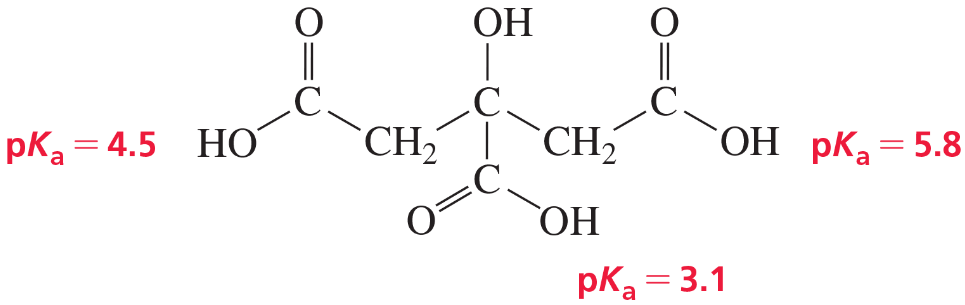
 Verified step by step guidance
 07:45
07:45
 1:05
1:05 02:41
02:41a. Without using a calculator, estimate the pH of each of the following solutions:
1. [HO−] = 3.2 × 10⁻⁵
2. [H3O+] = 8.3 × 10⁻¹
3. [H3O+] = 1.7 × 10⁻³
b. Determine the exact pH, using a calculator.
Given that pH + pOH = 14 and that the concentration of water in a solution of water is 55.5 M, show that the pKa of water is 15.7. (Hint: pOH=−log [HO−])
Citrus fruits are rich in citric acid, a compound with three COOH groups. Explain the following:
a. The first pKa (for the COOH group in the center of the molecule) is lower than the pKa of acetic acid.
You are planning to carry out a reaction that produces protons. The reaction will be buffered at pH = 10.5. Would it be better to use a protonated methylamine/methylamine buffer or a protonated ethylamine/ethylamine buffer? (pKa of protonated methylamine = 10.7; pKa of protonated ethylamine = 11.0)
How could you separate a mixture of the following compounds? The reagents available to you are water, ether, 1.0 M HCl, and 1.0 M NaOH.
If an acid with a pKa of 5.3 is in an aqueous solution of pH 5.7, what percentage of the acid is present in its acidic form?