Ch. 2 - Acids and Bases: Central to Understanding Organic Chemistry
Bruice - Organic Chemistry 8th Edition
Bruice8th EditionOrganic ChemistryISBN: 9780135213711Not the one you use?Change textbook
Chapter 3, Problem 73

Given that pH + pOH = 14 and that the concentration of water in a solution of water is 55.5 M, show that the pKa of water is 15.7. (Hint: pOH=−log [HO−])

Verified step by step guidance
1
Step 1: Start by recalling the relationship between pH, pOH, and the ionization constant of water (Kw). The equation pH + pOH = 14 is derived from the fact that Kw = [H3O+] × [HO−] = 1 × 10^−14 at 25°C.
Step 2: Use the hint provided, which states that pOH = −log [HO−]. This means the concentration of hydroxide ions ([HO−]) can be expressed as 10^(−pOH).
Step 3: Recognize that the ionization constant of water (Kw) can also be expressed in terms of pKa. The relationship is pKa = −log Ka, where Ka is the acid dissociation constant. For water, Ka = Kw / [H2O].
Step 4: Substitute the known values into the equation for Ka. Kw = 1 × 10^−14 and the concentration of water ([H2O]) is given as 55.5 M. Therefore, Ka = (1 × 10^−14) / 55.5.
Step 5: Calculate the pKa using the formula pKa = −log Ka. Substitute the value of Ka obtained in Step 4 into this formula to find the pKa of water, which is approximately 15.7.

Verified video answer for a similar problem:

This video solution was recommended by our tutors as helpful for the problem above.
Video duration:
8m
Was this helpful?

Key Concepts

Here are the essential concepts you must grasp in order to answer the question correctly.

pH and pOH

pH is a measure of the hydrogen ion concentration in a solution, while pOH measures the hydroxide ion concentration. The relationship pH + pOH = 14 is fundamental in aqueous solutions at 25°C, indicating that as the concentration of one ion increases, the other decreases. This relationship is crucial for understanding acid-base equilibria and calculating the acidity or basicity of a solution.
Recommended video:
Guided course
02:15
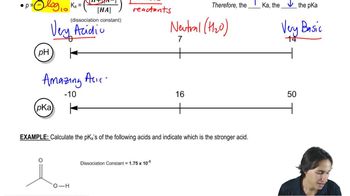
The pH scale vs. the pKa scale.

Ion Product of Water (Kw)

The ion product of water, Kw, is the equilibrium constant for the self-ionization of water, defined as Kw = [H+][OH-]. At 25°C, Kw is approximately 1.0 x 10^-14. This value is essential for calculating pKa and pKb values, as it relates the concentrations of hydrogen and hydroxide ions in pure water and helps determine the acidity of solutions.
Recommended video:
1:35
Metal Ion Catalysis: Water Activation Concept 1

pKa and its Relation to Water

pKa is the negative logarithm of the acid dissociation constant (Ka) and indicates the strength of an acid in solution. For water, the pKa can be derived from the relationship between pH, pOH, and Kw. Since the pKa of water is derived from the dissociation of water into H+ and OH-, it reflects the intrinsic acidity of water, which is relevant for understanding acid-base reactions in aqueous solutions.
Recommended video:
Guided course
07:45
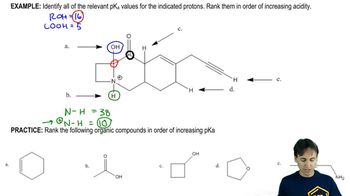
Identifying pKa values