
Ch. 20 - The Organic Chemistry of Carbohydrates
Bruice - Organic Chemistry 8th Edition
Bruice8th EditionOrganic ChemistryISBN: 9780135213711Not the one you use?Change textbook
Chapter 21, Problem 69

Predict whether D-altrose exists preferentially as a pyranose or a furanose. (Hint: In the most stable arrangement for a five-membered ring, all the adjacent substituents are trans.)

Verified step by step guidance
1
Analyze the structure of d-altrose: d-altrose is an aldohexose, meaning it contains six carbon atoms and an aldehyde functional group. It has four chiral centers, and its stereochemistry determines the orientation of its hydroxyl groups.
Understand the formation of pyranose and furanose rings: Pyranose rings are six-membered rings (five carbons and one oxygen), while furanose rings are five-membered rings (four carbons and one oxygen). Both forms result from the intramolecular reaction between the carbonyl group (C=O) and a hydroxyl group (-OH) on the sugar.
Consider the stability of the furanose form: In a five-membered furanose ring, the most stable arrangement occurs when adjacent substituents are trans to each other. Examine the stereochemistry of d-altrose to determine if this arrangement is possible and favorable.
Evaluate the stability of the pyranose form: In a six-membered pyranose ring, stability is influenced by the ability to adopt a chair conformation, minimizing steric hindrance and placing bulky groups in equatorial positions. Analyze the stereochemistry of d-altrose to determine if this conformation is more favorable than the furanose form.
Compare the two forms: Based on the stereochemical analysis and the stability considerations for both pyranose and furanose forms, predict which form is preferentially adopted by d-altrose. Remember that the most stable form will minimize steric hindrance and maximize favorable interactions.

Verified video answer for a similar problem:

This video solution was recommended by our tutors as helpful for the problem above.
Video duration:
4m
Was this helpful?

Key Concepts

Here are the essential concepts you must grasp in order to answer the question correctly.

Pyranose and Furanose Forms

Pyranose and furanose are two cyclic forms of monosaccharides. Pyranose is a six-membered ring structure, while furanose is a five-membered ring. The stability of these forms is influenced by steric interactions and the orientation of substituents around the ring. Understanding these structures is crucial for predicting the preferred form of sugars like d-altrose.
Recommended video:
Guided course
06:23
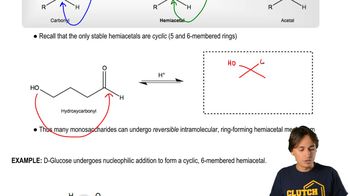
Monosaccharides - Forming Cyclic Hemiacetals

Chair and Boat Conformations

In the context of pyranose rings, the chair and boat conformations describe the spatial arrangement of atoms in the ring. The chair conformation is generally more stable due to minimized steric strain and torsional strain, allowing substituents to be positioned equatorially. This concept is essential for understanding how substituent orientation affects the stability of cyclic sugars.
Recommended video:
Guided course
02:22
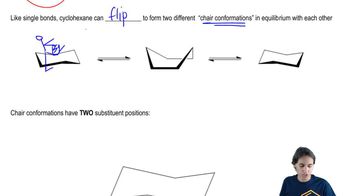
How chairs flip from one conformation to another

Trans and Cis Substituent Orientation

The terms trans and cis refer to the relative positioning of substituents on a ring structure. In a trans arrangement, substituents are positioned on opposite sides, which often leads to lower steric hindrance and greater stability. This concept is particularly relevant when predicting the preferred form of d-altrose, as the hint suggests that the most stable arrangement favors trans orientations.
Recommended video:
Guided course
00:44
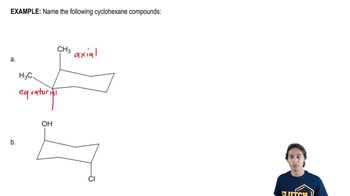
Is the following cyclohexane cis or trans?
Related Practice
Textbook Question

When a pyranose is in the chair conformation in which the CH2OH group and the C-1 OH group are both in axial positions, the two groups can react to form an acetal. This is called the anhydro form of the sugar (it has 'lost water'). The anhydro form of d-idose is shown here. Explain why about 80% of d-idose exists in the anhydro form in an aqueous solution at 100 °C, but only about 0.1% of d-glucose exists in the anhydro form under the same conditions.

1490
views
Textbook Question

An unknown disaccharide gives a positive Tollens' test. A glycosidase hydrolyzes it to D-galactose and D-mannose. When the disaccharide is treated with methyl iodide and Ag2O and then hydrolyzed with dilute HCl, the products are 2,3,4,6-tetra-O-methylgalactose and 2,3,4-tri-O-methylmannose. Propose a structure for the disaccharide.

1728
views
Textbook Question

Trehalose, C12H22O11, is a nonreducing sugar that is only 45% as sweet as sugar. When hydrolyzed by aqueous acid or the enzyme maltase, it forms only D-glucose. When it is treated with excess methyl iodide in the presence of Ag2O and then hydrolyzed with water under acidic conditions, only 2,3,4,6-tetra-O-methyl-d-glucose is formed. Draw the structure of trehalose.

1176
views
Textbook Question

The specific rotation of α-D-galactose is 150.7 and that of β-D-galactose is 52.8. When an aqueous mixture that was initially 70% α-D-galactose and 30% β-D-galactose reaches equilibrium, the specific rotation is 80.2. What is the percentage of α-D-galactose and β-D galactose at equilibrium?

1174
views
Textbook Question

Propose a mechanism for the rearrangement that converts an ⍺-hydroxyimine to an ⍺-aminoketone in the presence of a trace amount of acid.

1418
views
Textbook Question

Draw the mechanism for the elimination step in the Wohl degredation.

1168
views