
Ch. 20 - The Organic Chemistry of Carbohydrates
Bruice - Organic Chemistry 8th Edition
Bruice8th EditionOrganic ChemistryISBN: 9780135213711Not the one you use?Change textbook
Chapter 21, Problem 73

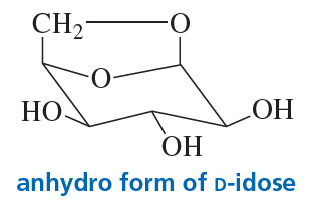
When a pyranose is in the chair conformation in which the CH2OH group and the C-1 OH group are both in axial positions, the two groups can react to form an acetal. This is called the anhydro form of the sugar (it has 'lost water'). The anhydro form of d-idose is shown here. Explain why about 80% of d-idose exists in the anhydro form in an aqueous solution at 100 °C, but only about 0.1% of d-glucose exists in the anhydro form under the same conditions.
Structural diagram of the anhydro form of d-idose, showing CH2OH and C-1 OH groups in axial positions.

Verified step by step guidance
1
Step 1: Analyze the chair conformation of d-idose and d-glucose. In the chair conformation, the axial positions of the CH2OH group and the C-1 OH group in d-idose allow them to be in close proximity, facilitating the intramolecular reaction to form the anhydro form. In d-glucose, these groups are not both in axial positions, making the reaction less favorable.
Step 2: Consider the steric and electronic factors. The axial positioning in d-idose minimizes steric hindrance and aligns the reactive groups for acetal formation. In d-glucose, the equatorial positioning of the CH2OH group increases steric hindrance and misaligns the reactive groups, reducing the likelihood of acetal formation.
Step 3: Evaluate the thermodynamic stability of the anhydro form. The anhydro form of d-idose is stabilized by the chair conformation and the intramolecular acetal bond, making it energetically favorable at high temperatures (100 °C). For d-glucose, the anhydro form is less stable due to unfavorable conformational alignment.
Step 4: Consider the equilibrium dynamics in aqueous solution. At 100 °C, the equilibrium shifts toward the anhydro form for d-idose due to its stability and favorable reaction kinetics. For d-glucose, the equilibrium remains largely in favor of the pyranose form due to the unfavorable conditions for acetal formation.
Step 5: Relate the percentage of anhydro form observed. The structural and thermodynamic factors explain why about 80% of d-idose exists in the anhydro form in aqueous solution at 100 °C, while only about 0.1% of d-glucose exists in the anhydro form under the same conditions.

Verified video answer for a similar problem:

This video solution was recommended by our tutors as helpful for the problem above.
Video duration:
2m
Was this helpful?

Key Concepts

Here are the essential concepts you must grasp in order to answer the question correctly.

Chair Conformation

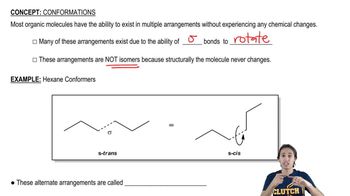
The chair conformation is a three-dimensional arrangement of cyclohexane rings that minimizes steric strain and allows for optimal positioning of substituents. In sugars like pyranoses, this conformation helps to stabilize the molecule, influencing the reactivity of functional groups. The axial and equatorial positions of substituents in this conformation play a crucial role in determining the accessibility of reactive sites.
Recommended video:
Guided course
03:29
Understanding what a conformer is.

Anhydro Form

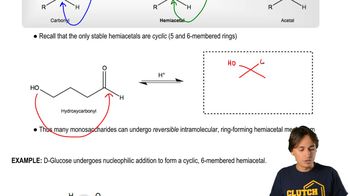
The anhydro form of a sugar is a cyclic structure that results from the loss of a water molecule, typically during a condensation reaction. This form is significant in carbohydrate chemistry as it can affect the solubility and reactivity of sugars in aqueous solutions. The stability of the anhydro form can vary between different sugars, influencing their prevalence in solution under specific conditions.
Recommended video:
Guided course
06:23
Monosaccharides - Forming Cyclic Hemiacetals

Reactivity of Sugars

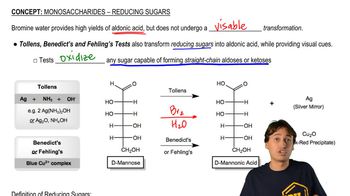
The reactivity of sugars, particularly in forming acetals or anhydro forms, is influenced by their structural features, such as the orientation of hydroxyl groups and the presence of reactive functional groups. In the case of d-idose and d-glucose, differences in their molecular structure lead to variations in their ability to undergo reactions in aqueous solutions. Factors like steric hindrance and electronic effects can significantly impact the formation of the anhydro form.
Recommended video:
Guided course
08:42
Reducing Sugars