
Ch. 20 - The Organic Chemistry of Carbohydrates
Bruice - Organic Chemistry 8th Edition
Bruice8th EditionOrganic ChemistryISBN: 9780135213711Not the one you use?Change textbook
Chapter 21, Problem 71

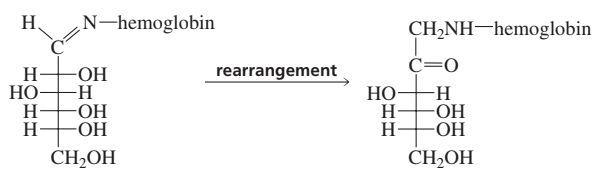
Propose a mechanism for the rearrangement that converts an ⍺-hydroxyimine to an ⍺-aminoketone in the presence of a trace amount of acid.
Mechanism showing the rearrangement of an α-hydroxyimine to an α-aminoketone with hemoglobin involvement.

Verified step by step guidance
1
Step 1: Protonation of the hydroxyl group (-OH) on the α-hydroxyimine occurs in the presence of trace acid (H₃O⁺). This increases the electrophilicity of the carbon atom attached to the hydroxyl group, making it more susceptible to nucleophilic attack.
Step 2: The protonated hydroxyl group (-OH₂⁺) leaves as water (H₂O), generating a carbocation at the α-carbon. This carbocation is stabilized by resonance with the imine group.
Step 3: The lone pair of electrons on the nitrogen atom of the imine group migrates to form a double bond with the α-carbon, resulting in the formation of a new bond and shifting the positive charge onto the nitrogen atom.
Step 4: A molecule of water (H₂O) attacks the positively charged nitrogen atom, leading to the formation of an intermediate where the nitrogen is bonded to both the α-carbon and a hydroxyl group.
Step 5: Deprotonation of the hydroxyl group on the nitrogen occurs, resulting in the final product: an α-aminoketone, where the α-carbon is bonded to a ketone group and the nitrogen is bonded to a hydrogen atom.

Verified video answer for a similar problem:

This video solution was recommended by our tutors as helpful for the problem above.
Video duration:
7m
Was this helpful?

Key Concepts

Here are the essential concepts you must grasp in order to answer the question correctly.

Hydroxyimine Structure

A-hydroxyimines are compounds containing a hydroxyl group (-OH) and an imine group (C=N) on adjacent carbon atoms. This structure is crucial for understanding the rearrangement mechanism, as the hydroxyl group can participate in protonation and subsequent reactions under acidic conditions, facilitating the conversion to an a-aminoketone.
Recommended video:
Guided course
03:04
Drawing Resonance Structures

Protonation and Acid Catalysis

In the presence of a trace amount of acid, such as H3O+, protonation of the hydroxyl group occurs, enhancing its leaving ability. This step is essential in the mechanism, as it leads to the formation of a more reactive intermediate that can rearrange to form the a-aminoketone, demonstrating the role of acid catalysis in organic reactions.
Recommended video:
2:50
Acid-Base Catalysis Concept 3

Rearrangement Mechanism

The rearrangement mechanism involves the transformation of the a-hydroxyimine to an a-aminoketone through a series of steps, including protonation, loss of water, and reorganization of the double bond. Understanding this mechanism is vital for predicting the product and the reaction pathway, highlighting the importance of structural changes in organic synthesis.
Recommended video:
Guided course
06:08
Definition of Claisen Rearrangement