Ch. 4 - Isomers: The Arrangement of Atoms in Space
Bruice - Organic Chemistry 8th Edition
Bruice8th EditionOrganic ChemistryISBN: 9780135213711Not the one you use?Change textbook
Chapter 5, Problem 81

A solution of an unknown compound (3.0 g of the compound in 200 mL of solution), when placed in a polarimeter tube 2.0 dm long, was found to rotate the plane of polarized light 18° in a counterclockwise direction. What is the specific rotation of the compound?

Verified step by step guidance
1
Step 1: Recall the formula for specific rotation: \( [\alpha] = \frac{\alpha}{l \cdot c} \), where \( [\alpha] \) is the specific rotation, \( \alpha \) is the observed rotation, \( l \) is the path length in decimeters, and \( c \) is the concentration in g/mL.
Step 2: Identify the given values from the problem: \( \alpha = -18^{\circ} \) (negative because the rotation is counterclockwise), \( l = 2.0 \, \text{dm} \), and the concentration \( c \) can be calculated as \( c = \frac{\text{mass of compound}}{\text{volume of solution}} = \frac{3.0 \, \text{g}}{200 \, \text{mL}} \).
Step 3: Calculate the concentration \( c \) by dividing the mass of the compound (3.0 g) by the volume of the solution (200 mL). This will give the concentration in g/mL.
Step 4: Substitute the values of \( \alpha \), \( l \), and \( c \) into the formula \( [\alpha] = \frac{\alpha}{l \cdot c} \). Ensure the units are consistent (e.g., \( l \) in dm and \( c \) in g/mL).
Step 5: Simplify the expression to find the specific rotation \( [\alpha] \). Remember to include the negative sign in the final calculation since the rotation is counterclockwise.

Verified video answer for a similar problem:

This video solution was recommended by our tutors as helpful for the problem above.
Video duration:
1m
Was this helpful?

Key Concepts

Here are the essential concepts you must grasp in order to answer the question correctly.

Specific Rotation

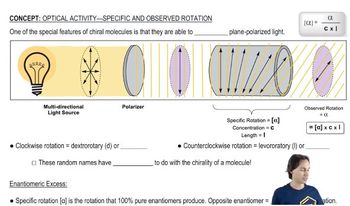
Specific rotation is a property of chiral compounds that quantifies their ability to rotate plane-polarized light. It is defined as the observed rotation of light (in degrees) divided by the concentration of the solution (in grams per milliliter) and the path length of the sample (in decimeters). The formula is [α] = α / (c × l), where [α] is the specific rotation, α is the observed rotation, c is the concentration, and l is the path length.
Recommended video:
Guided course
05:43
Specific rotation vs. observed rotation.

Chirality

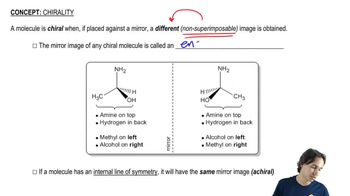
Chirality refers to the geometric property of a molecule that makes it non-superimposable on its mirror image, much like left and right hands. Chiral molecules often exist as enantiomers, which are pairs of molecules that are mirror images of each other. The ability of chiral compounds to rotate polarized light is a key characteristic that is utilized in determining their specific rotation.
Recommended video:
Guided course
05:10
What is chirality?

Polarimetry

Polarimetry is an analytical technique used to measure the angle of rotation of polarized light as it passes through a sample. This technique is particularly useful for studying chiral substances, as the degree of rotation can provide insights into the concentration and specific rotation of the compound. The polarimeter consists of a light source, a polarizer, a sample tube, and an analyzer to measure the rotation.
Related Practice
Textbook Question

The specific rotation of (R)-(+)-glyceraldehyde is +8.7. If the observed specific rotation of a mixture of (R)-glyceraldehyde and (S)-glyceraldehyde is +1.4, what percent of glyceraldehyde is present as the R enantiomer?

1099
views

Textbook Question

Are the following pairs identical, enantiomers, diastereomers, or constitutional isomers?

c.

d.

1139
views
Textbook Question

Are the following pairs identical, enantiomers, diastereomers, or constitutional isomers?

a.

b.

2992
views
1
rank
Textbook Question

Citrate synthase, one of the enzymes in the series of enzyme-catalyzed reactions known as the citric acid cycle, catalyzes the synthesis of citric acid from oxaloacetic acid and acetyl-CoA. If the synthesis is carried out with acetyl-CoA that contains radioactive carbon (14C) in the indicated position, the isomer shown here is obtained.

b. If the acetyl-CoA used in the synthesis contains 12C instead of 14C, will the product of the reaction be chiral or achiral?

1236
views
Textbook Question

Indicate whether each of the following structures is (R)-2-chlorobutane or (S)-2-chlorobutane:

a.

b.

1810
views
Textbook Question

Citrate synthase, one of the enzymes in the series of enzyme-catalyzed reactions known as the citric acid cycle, catalyzes the synthesis of citric acid from oxaloacetic acid and acetyl-CoA. If the synthesis is carried out with acetyl-CoA that contains radioactive carbon (14C) in the indicated position, the isomer shown here is obtained.

a. Which stereoisomer of citric acid is synthesized: R or S?

1616
views