The specific rotation of (R)-(+)-glyceraldehyde is +8.7. If the observed specific rotation of a mixture of (R)-glyceraldehyde and (S)-glyceraldehyde is +1.4, what percent of glyceraldehyde is present as the R enantiomer?
Ch. 4 - Isomers: The Arrangement of Atoms in Space
Chapter 5, Problem 84a,b
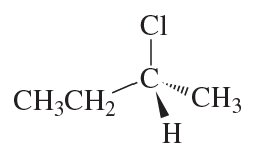
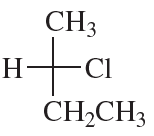
Indicate whether each of the following structures is (R)-2-chlorobutane or (S)-2-chlorobutane:
a. 
b. 
Verified step by step guidance1
Step 1: Identify the chiral center in each structure. In both structures (a and b), the carbon atom bonded to Br, H, CH3CH2, and CH2CH2CH3 is the chiral center.
Step 2: Assign priorities to the substituents around the chiral center based on the Cahn-Ingold-Prelog priority rules. The substituent with the highest atomic number gets the highest priority. Here, Br > CH2CH2CH3 > CH3CH2 > H.
Step 3: Orient the molecule so that the lowest priority group (H) is pointing away from you (on the dashed wedge). For structure (a), this orientation is already provided. For structure (b), you may need to mentally rotate the molecule to achieve this orientation.
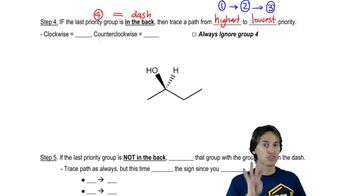
Step 4: Determine the order of the remaining substituents (1, 2, 3) in a clockwise or counterclockwise direction. If the sequence is clockwise, the configuration is (R). If the sequence is counterclockwise, the configuration is (S).
Step 5: Based on the analysis, assign the configuration (R or S) to each structure. Structure (a) and structure (b) will have their respective configurations determined by the above steps.

Verified video answer for a similar problem:
This video solution was recommended by our tutors as helpful for the problem above.
Video duration:
5mWas this helpful?
Key Concepts
Here are the essential concepts you must grasp in order to answer the question correctly.
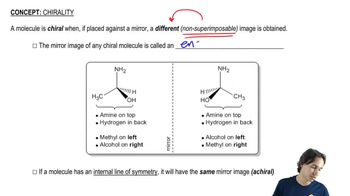
Chirality
Chirality refers to the geometric property of a molecule that makes it non-superimposable on its mirror image. A chiral molecule typically has a carbon atom bonded to four different substituents, leading to two distinct configurations known as enantiomers. In the case of 2-chlorobutane, the presence of the chlorine atom and the different alkyl groups creates chirality, resulting in (R) and (S) forms.
Recommended video:
Guided course
What is chirality?
Cahn-Ingold-Prelog Priority Rules
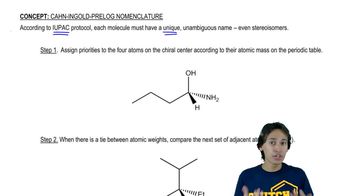
The Cahn-Ingold-Prelog (CIP) priority rules are a set of guidelines used to assign priorities to the substituents attached to a chiral center. According to these rules, the substituents are ranked based on atomic number; higher atomic numbers receive higher priority. This ranking is crucial for determining the (R) or (S) configuration of chiral compounds, as it dictates the order in which the substituents are arranged.
Recommended video:
Guided course
Why stereoisomers need their own naming system.
R and S Nomenclature
R and S nomenclature is a system used to describe the configuration of chiral centers in organic molecules. The 'R' (rectus) designation indicates a clockwise arrangement of the highest priority substituents when viewed from a specific angle, while 'S' (sinister) indicates a counterclockwise arrangement. This nomenclature is essential for distinguishing between the two enantiomers of compounds like 2-chlorobutane, which can have different physical and chemical properties.
Recommended video:
Guided course
R and S Naming- Step 4
Related Practice
Textbook Question
1099
views
Textbook Question
A solution of an unknown compound (3.0 g of the compound in 200 mL of solution), when placed in a polarimeter tube 2.0 dm long, was found to rotate the plane of polarized light 18° in a counterclockwise direction. What is the specific rotation of the compound?
1563
views
Textbook Question
Indicate whether each of the following structures is (R)-2-chlorobutane or (S)-2-chlorobutane:
c.
d.
793
views
Textbook Question
Are the following pairs identical, enantiomers, diastereomers, or constitutional isomers?
c.
d.
1139
views
Textbook Question
Butaclamol is a potent antipsychotic that has been used clinically in the treatment of schizophrenia. How many asymmetric centers does it have?
1184
views
Textbook Question
Indicate whether each of the following structures is (R)-2-chlorobutane or (S)-2-chlorobutane:
e.
f.
1526
views