
Ch. 4 - Isomers: The Arrangement of Atoms in Space
Bruice - Organic Chemistry 8th Edition
Bruice8th EditionOrganic ChemistryISBN: 9780135213711Not the one you use?Change textbook
Chapter 5, Problem 83

The specific rotation of (R)-(+)-glyceraldehyde is +8.7. If the observed specific rotation of a mixture of (R)-glyceraldehyde and (S)-glyceraldehyde is +1.4, what percent of glyceraldehyde is present as the R enantiomer?

Verified step by step guidance
1
Step 1: Recall the formula for calculating the observed specific rotation of a mixture: \( \text{[α]}_{\text{obs}} = \text{[α]}_{\text{R}} \cdot \text{fraction}_{\text{R}} + \text{[α]}_{\text{S}} \cdot \text{fraction}_{\text{S}} \). Here, \( \text{[α]}_{\text{R}} \) is the specific rotation of the R enantiomer, \( \text{[α]}_{\text{S}} \) is the specific rotation of the S enantiomer, and \( \text{fraction}_{\text{R}} + \text{fraction}_{\text{S}} = 1 \).
Step 2: Substitute the given values into the formula. The specific rotation of (R)-(+)-glyceraldehyde is \( +8.7 \), and the observed specific rotation of the mixture is \( +1.4 \). Since the S enantiomer is the opposite of the R enantiomer, \( \text{[α]}_{\text{S}} = -8.7 \). The equation becomes \( +1.4 = (+8.7 \cdot \text{fraction}_{\text{R}}) + (-8.7 \cdot \text{fraction}_{\text{S}}) \).
Step 3: Replace \( \text{fraction}_{\text{S}} \) with \( 1 - \text{fraction}_{\text{R}} \) because the sum of the fractions of the R and S enantiomers must equal 1. The equation now becomes \( +1.4 = (+8.7 \cdot \text{fraction}_{\text{R}}) + (-8.7 \cdot (1 - \text{fraction}_{\text{R}})) \).
Step 4: Simplify the equation by distributing \( -8.7 \) across \( (1 - \text{fraction}_{\text{R}}) \). This results in \( +1.4 = (+8.7 \cdot \text{fraction}_{\text{R}}) - 8.7 + (8.7 \cdot \text{fraction}_{\text{R}}) \). Combine like terms to get \( +1.4 = 17.4 \cdot \text{fraction}_{\text{R}} - 8.7 \).
Step 5: Solve for \( \text{fraction}_{\text{R}} \) by isolating it on one side of the equation. Add \( 8.7 \) to both sides and then divide by \( 17.4 \). Once \( \text{fraction}_{\text{R}} \) is determined, multiply it by 100 to find the percentage of glyceraldehyde present as the R enantiomer.

Verified video answer for a similar problem:

This video solution was recommended by our tutors as helpful for the problem above.
Video duration:
4m
Was this helpful?

Key Concepts

Here are the essential concepts you must grasp in order to answer the question correctly.

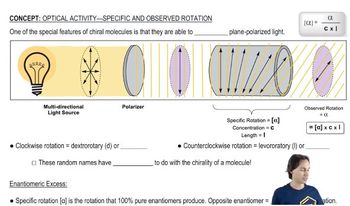
Specific Rotation

Specific rotation is a measure of how much a chiral compound rotates plane-polarized light, expressed in degrees. It is defined as the observed rotation divided by the concentration of the solution and the path length of the light. This property is crucial for distinguishing between enantiomers, as each enantiomer will rotate light in opposite directions.
Recommended video:
Guided course
05:43
Specific rotation vs. observed rotation.

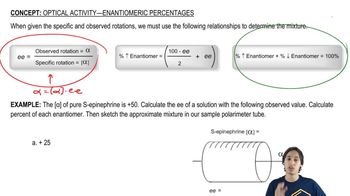
Enantiomers

Enantiomers are pairs of molecules that are non-superimposable mirror images of each other, often differing in their optical activity. In the case of glyceraldehyde, (R)-glyceraldehyde and (S)-glyceraldehyde are enantiomers, with distinct specific rotations. Understanding the relationship between enantiomers is essential for calculating the composition of a mixture based on its observed specific rotation.
Recommended video:
Guided course
03:23
How to solve for the percentage of each enantiomer.

Optical Purity

Optical purity is a measure of the proportion of one enantiomer in a mixture relative to the total amount of both enantiomers. It can be calculated using the formula: optical purity = (observed specific rotation / specific rotation of pure enantiomer) × 100%. This concept is vital for determining the percentage of the (R)-glyceraldehyde in the mixture based on the observed specific rotation.
Recommended video:
Guided course
08:17
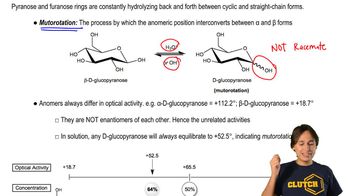
Mutorotation and Optical Activity