Ch. 5 - Alkenes: Structure, Nomenclature, and an Introduction to Reactivity • Thermodynamics and Kinetics
Bruice - Organic Chemistry 8th Edition
Bruice8th EditionOrganic ChemistryISBN: 9780135213711Not the one you use?Change textbook
Chapter 6, Problem 5b

Determine the degree of unsaturation and then draw possible structures for noncyclic compounds with the following molecular formulas:
b. C3H4

Verified step by step guidance
1
Step 1: Understand the concept of degree of unsaturation. The degree of unsaturation (also called the index of hydrogen deficiency) indicates the number of π bonds or rings in a molecule. It is calculated using the formula: \( \text{Degree of Unsaturation} = rac{2C + 2 - H}{2} \), where \( C \) is the number of carbon atoms, \( H \) is the number of hydrogen atoms, and other elements like oxygen or halogens are accounted for separately.
Step 2: Apply the formula to the given molecular formula \( C_3H_4 \). Substitute \( C = 3 \) and \( H = 4 \) into the formula: \( \text{Degree of Unsaturation} = rac{2(3) + 2 - 4}{2} \). Simplify the expression to determine the degree of unsaturation.
Step 3: Interpret the result. A degree of unsaturation of 2 means the molecule has two π bonds, two rings, or one π bond and one ring. Since the problem specifies noncyclic compounds, focus on structures with π bonds only.
Step 4: Draw possible structures for \( C_3H_4 \) that satisfy the degree of unsaturation. Consider linear arrangements of the carbon atoms and distribute the π bonds accordingly. Examples include molecules with triple bonds (alkynes) or two double bonds (dienes).
Step 5: Verify the structures. Ensure that each proposed structure adheres to the molecular formula \( C_3H_4 \), satisfies the degree of unsaturation, and follows the rules of valency for carbon and hydrogen atoms.

Verified video answer for a similar problem:

This video solution was recommended by our tutors as helpful for the problem above.
Video duration:
6m
Was this helpful?

Key Concepts

Here are the essential concepts you must grasp in order to answer the question correctly.

Degree of Unsaturation

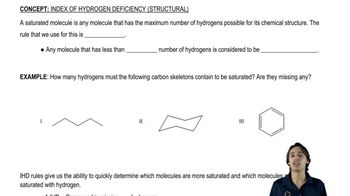
The degree of unsaturation (DU) indicates the number of rings and/or multiple bonds in a molecule. It can be calculated using the formula DU = (2C + 2 + N - H - X)/2, where C is the number of carbons, N is the number of nitrogens, H is the number of hydrogens, and X is the number of halogens. A higher DU suggests more double bonds or rings, which significantly influences the compound's reactivity and structure.
Recommended video:
Guided course
02:39
The difference between saturated and unsaturated molecules.

Structural Isomers

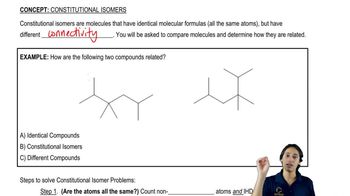
Structural isomers are compounds that have the same molecular formula but differ in the arrangement of atoms. For C3H4, possible structural isomers include alkenes and alkynes, which can exhibit different connectivity of carbon atoms and functional groups. Understanding structural isomerism is crucial for predicting the physical and chemical properties of the compounds.
Recommended video:
Guided course
01:10
What is a constitutional isomer?

Noncyclic Compounds

Noncyclic compounds are organic molecules that do not contain any rings in their structure. For the molecular formula C3H4, noncyclic compounds can include alkenes (with a double bond) and alkynes (with a triple bond). Recognizing the distinction between cyclic and noncyclic structures is essential for accurately drawing and interpreting the possible configurations of a given molecular formula.
Recommended video:
Guided course
01:40
Defining meso compounds.