Ch. 5 - Alkenes: Structure, Nomenclature, and an Introduction to Reactivity • Thermodynamics and Kinetics
Bruice - Organic Chemistry 8th Edition
Bruice8th EditionOrganic ChemistryISBN: 9780135213711Not the one you use?Change textbook
Chapter 6, Problem 6a

Several studies have shown that β-carotene, a precursor of vitamin A, may play a role in preventing cancer. β-Carotene has a molecular formula of C40H56, and it contains two rings and no triple bonds. How many double bonds does it have?

Verified step by step guidance
1
Determine the degree of unsaturation (also known as the index of hydrogen deficiency, IHD) for the molecule using the molecular formula C40H56. The formula for IHD is: IHD = (2C + 2 - H)/2, where C is the number of carbons and H is the number of hydrogens.
Substitute the values for C and H into the IHD formula: IHD = (2(40) + 2 - 56)/2. Simplify the expression to calculate the degree of unsaturation.
Interpret the IHD value. Each unit of IHD corresponds to either a double bond, a ring, or a triple bond. Since the problem states that the molecule contains two rings and no triple bonds, subtract 2 (for the rings) from the IHD value to determine the number of double bonds.
Verify the molecular structure of β-carotene. Ensure that the calculated number of double bonds aligns with the molecular formula and the structural constraints (e.g., no triple bonds, two rings).
Conclude the number of double bonds in β-carotene based on the IHD calculation and the structural information provided in the problem.

Verified video answer for a similar problem:

This video solution was recommended by our tutors as helpful for the problem above.
Was this helpful?

Key Concepts

Here are the essential concepts you must grasp in order to answer the question correctly.

Molecular Formula Interpretation

The molecular formula of a compound provides information about the number and types of atoms present. In the case of b-carotene, C40H56 indicates that there are 40 carbon atoms and 56 hydrogen atoms. Understanding how to interpret this formula is essential for deducing structural features, such as the presence of double bonds.
Recommended video:
Guided course
02:17
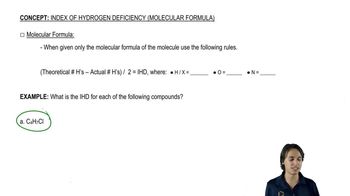
How to use IHD with molecular formula.

Unsaturation and Double Bonds

Unsaturation in organic compounds refers to the presence of double or triple bonds between carbon atoms. Each double bond reduces the number of hydrogen atoms that can be attached to the carbon skeleton. The degree of unsaturation can be calculated using the formula: (2C + 2 - H)/2, where C is the number of carbons and H is the number of hydrogens, helping to determine the number of double bonds in b-carotene.
Recommended video:
Guided course
06:00
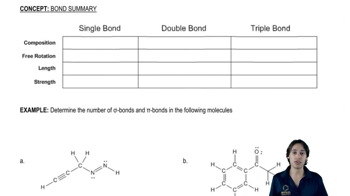
Single bonds, double bonds, and triple bonds.

Structure of b-Carotene

b-Carotene is a carotenoid with a specific structure that includes two conjugated double bond systems within its rings. The arrangement of these double bonds contributes to its color and biological activity. Recognizing the structural features of b-carotene is crucial for understanding its chemical properties and potential health benefits.
Recommended video:
Guided course
14:01
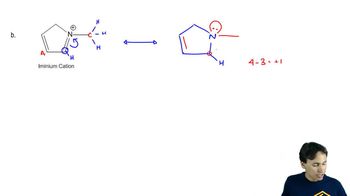
Drawing Contributing Structures