Ch. 6 - The Reactions of Alkenes • The Stereochemistry of Addition Reactions
Bruice - Organic Chemistry 8th Edition
Bruice8th EditionOrganic ChemistryISBN: 9780135213711Not the one you use?Change textbook
Chapter 7, Problem 43

The reaction of 2-ethyl-1-pentene with Br2, with H2 + Pd/C, or with R2BH/THF followed by aqueous HO- + H2O2 leads to a racemic mixture. Explain why a racemic mixture is obtained in each case.

Verified step by step guidance
1
The first reaction involves the addition of Br2 to 2-ethyl-1-pentene. This is an electrophilic addition reaction where the π-bond of the alkene reacts with Br2, forming a bromonium ion intermediate. The bromonium ion is planar, allowing the nucleophilic attack by Br⁻ to occur from either side of the plane, leading to the formation of a racemic mixture of enantiomers.
The second reaction involves the hydrogenation of 2-ethyl-1-pentene using H2 in the presence of Pd/C. This reaction converts the alkene into an alkane by syn-addition of hydrogen atoms. Since the starting alkene is not chiral, the product is achiral. However, if the reaction occurs on a chiral surface or if the product has a stereogenic center, a racemic mixture can result due to equal probability of hydrogen addition from either face of the planar π-bond.
The third reaction involves hydroboration-oxidation using R2BH/THF followed by aqueous HO⁻ and H2O2. In the hydroboration step, the boron atom adds to the less substituted carbon of the alkene, and the hydrogen adds to the more substituted carbon in a syn-addition manner. During the oxidation step, the boron is replaced by a hydroxyl group (-OH). If the product contains a stereogenic center, the reaction can produce a racemic mixture because the addition of boron and hydrogen can occur from either face of the planar π-bond.
In all three cases, the planar nature of the alkene's π-bond allows for equal probability of attack or addition from either side of the molecule. This symmetry leads to the formation of enantiomers in equal amounts, resulting in a racemic mixture.
The racemic mixture is a 1:1 mixture of two enantiomers, which are non-superimposable mirror images of each other. This occurs because the reaction conditions do not favor one enantiomer over the other, leading to no optical activity in the final product.

Verified video answer for a similar problem:

This video solution was recommended by our tutors as helpful for the problem above.
Video duration:
7m
Was this helpful?

Key Concepts

Here are the essential concepts you must grasp in order to answer the question correctly.

Stereochemistry

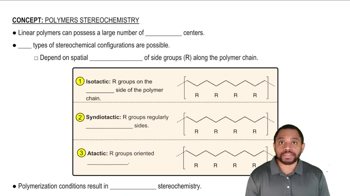
Stereochemistry is the study of the spatial arrangement of atoms in molecules and how this affects their chemical behavior. In the context of the reaction of 2-ethyl-1-pentene, the formation of a racemic mixture indicates that two enantiomers are produced in equal amounts, resulting from the addition of reagents that do not favor one stereoisomer over the other.
Recommended video:
1:38
Polymer Stereochemistry Concept 1

Electrophilic Addition Reactions

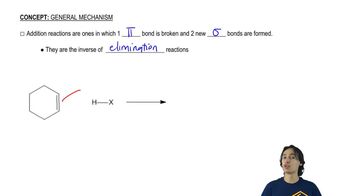
Electrophilic addition reactions involve the addition of electrophiles to alkenes, leading to the formation of more saturated compounds. In the case of 2-ethyl-1-pentene reacting with Br2 or other reagents, the planar nature of the alkene allows for the attack from either side, resulting in a mixture of products that includes both enantiomers.
Recommended video:
Guided course
05:39
Features of Addition Mechanisms.

Hydroboration-Oxidation

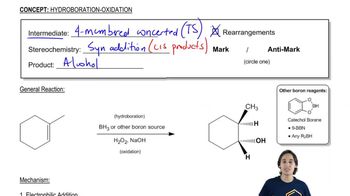
Hydroboration-oxidation is a two-step reaction where alkenes react with diborane (R2BH) to form organoboranes, which are then oxidized to alcohols. This process leads to syn-addition, but when followed by oxidation with hydrogen peroxide in a basic medium, it can also yield a racemic mixture due to the formation of a chiral center that is equally accessible from both sides.
Recommended video:
Guided course
06:38
General properties of hydroboration-oxidation.