Ch. 6 - The Reactions of Alkenes • The Stereochemistry of Addition Reactions
Bruice - Organic Chemistry 8th Edition
Bruice8th EditionOrganic ChemistryISBN: 9780135213711Not the one you use?Change textbook
Chapter 7, Problem 44

Using a sample of trans-2-pentene, how could you prove that the addition of Br2 forms a cyclic bromonium ion intermediate rather than a carbocation intermediate?

Verified step by step guidance
1
Step 1: Understand the reaction mechanism. The addition of Br₂ to an alkene like trans-2-pentene can proceed via two possible intermediates: a cyclic bromonium ion or a carbocation. The goal is to determine which intermediate is formed during the reaction.
Step 2: Analyze the stereochemical outcome of the reaction. If a cyclic bromonium ion intermediate is formed, the addition of Br₂ will result in an anti-addition (the two bromine atoms will add to opposite sides of the double bond). This is due to the backside attack of the nucleophile (Br⁻) on the bromonium ion.
Step 3: Perform the reaction and isolate the product. React trans-2-pentene with Br₂ in an inert solvent like CCl₄. After the reaction, isolate the dibromide product formed.
Step 4: Determine the stereochemistry of the product. Use techniques like NMR spectroscopy or X-ray crystallography to analyze the stereochemistry of the dibromide product. If the product is exclusively or predominantly anti (with bromines on opposite sides of the former double bond), it supports the formation of a cyclic bromonium ion intermediate.
Step 5: Consider the alternative mechanism. If a carbocation intermediate were formed, the addition of Br₂ could lead to a mixture of syn- and anti-products due to free rotation around the single bond in the planar carbocation. The absence of syn-products in the reaction strongly supports the bromonium ion mechanism.

Verified video answer for a similar problem:

This video solution was recommended by our tutors as helpful for the problem above.
Video duration:
7m
Was this helpful?

Key Concepts

Here are the essential concepts you must grasp in order to answer the question correctly.

Bromonium Ion Mechanism

The bromonium ion mechanism involves the formation of a cyclic intermediate when bromine (Br2) adds to an alkene. In this process, one bromine atom forms a bond with one of the carbon atoms in the double bond, while the other bromine atom is temporarily bonded to the other carbon, creating a three-membered ring structure. This intermediate is more stable than a carbocation due to the positive charge being shared between the two carbons.
Recommended video:
3:39
Metal Ion Catalysis Concept 1

Carbocation Stability

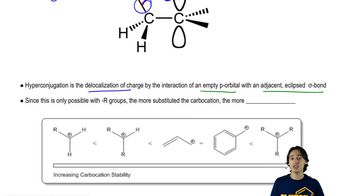
Carbocations are positively charged species that can form during electrophilic addition reactions. Their stability is influenced by the degree of substitution; tertiary carbocations are more stable than secondary or primary ones due to hyperconjugation and inductive effects. In the context of bromine addition, the formation of a carbocation would be less favorable compared to the formation of a bromonium ion, especially in less substituted alkenes like trans-2-pentene.
Recommended video:
Guided course
05:58
Determining Carbocation Stability

Stereochemistry of Addition Reactions

The stereochemistry of addition reactions is crucial for understanding the outcome of reactions involving alkenes. The formation of a bromonium ion leads to a specific stereochemical outcome, as the bromine atoms add to the same face of the double bond, resulting in anti-addition. This can be experimentally verified by analyzing the stereochemical configuration of the product, which would differ if a carbocation intermediate were formed.
Recommended video:
1:38
Polymer Stereochemistry Concept 1