Ch. 6 - The Reactions of Alkenes • The Stereochemistry of Addition Reactions
Bruice - Organic Chemistry 8th Edition
Bruice8th EditionOrganic ChemistryISBN: 9780135213711Not the one you use?Change textbook
Chapter 7, Problem 42c

What stereoisomers are obtained from hydroboration–oxidation of the following compounds? Assign an R or S configuration to each asymmetric center.
c. cis-2-butene

Verified step by step guidance
1
Identify the reaction: Hydroboration–oxidation is a two-step reaction. The first step involves the addition of borane (BH₃) to the alkene, and the second step involves oxidation with hydrogen peroxide (H₂O₂) in a basic medium (NaOH). This reaction proceeds via anti-Markovnikov addition, where the hydroxyl group (-OH) attaches to the less substituted carbon of the double bond.
Analyze the starting material: cis-2-butene is a symmetrical alkene with the double bond between carbons 2 and 3. The two methyl groups are on the same side of the double bond, making it a cis isomer.
Determine the stereochemistry of the product: Hydroboration–oxidation occurs with syn addition, meaning that both the hydrogen (H) and hydroxyl group (-OH) are added to the same face of the double bond. This syn addition will result in the formation of a pair of enantiomers (stereoisomers) because the starting material is symmetrical.
Assign R or S configuration: After the addition of -OH and H, the product will have two chiral centers (at carbons 2 and 3). To assign R or S configuration, prioritize the substituents on each chiral center based on the Cahn-Ingold-Prelog rules. Assign priorities to the groups attached to each chiral center, determine the direction of rotation (clockwise or counterclockwise), and assign R (clockwise) or S (counterclockwise) accordingly.
Conclude the stereoisomers: The reaction will yield a racemic mixture of two enantiomers, one with (2R,3R) configuration and the other with (2S,3S) configuration, due to the symmetrical nature of the starting material and the syn addition mechanism.

Verified video answer for a similar problem:

This video solution was recommended by our tutors as helpful for the problem above.
Video duration:
7m
Was this helpful?

Key Concepts

Here are the essential concepts you must grasp in order to answer the question correctly.

Stereoisomerism

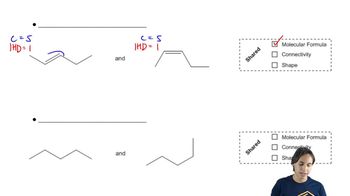
Stereoisomerism refers to the phenomenon where compounds have the same molecular formula and connectivity of atoms but differ in the spatial arrangement of those atoms. This can lead to different physical and chemical properties. In organic chemistry, stereoisomers include enantiomers and diastereomers, which are crucial for understanding reactions involving chiral centers.
Recommended video:
Guided course
01:58
Determining when molecules are stereoisomers.

Hydroboration-Oxidation

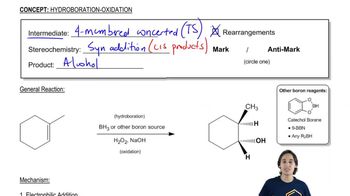
Hydroboration-oxidation is a two-step reaction process used to convert alkenes into alcohols. In the first step, borane (BH3) adds across the double bond of the alkene, resulting in a trialkylborane intermediate. The second step involves oxidation with hydrogen peroxide (H2O2) in a basic solution, leading to the formation of an alcohol. This reaction is stereospecific and results in anti-Markovnikov addition.
Recommended video:
Guided course
06:38
General properties of hydroboration-oxidation.

R and S Configuration

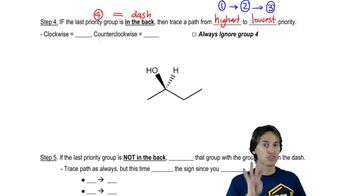
The R and S configuration system is used to describe the absolute configuration of chiral centers in molecules. To assign R or S, the substituents attached to the chiral carbon are ranked according to their atomic number. The configuration is determined by the orientation of the highest priority substituent: if it is clockwise, the configuration is R; if counterclockwise, it is S. This is essential for understanding the stereochemistry of the products formed in reactions.
Recommended video:
Guided course
03:07
R and S Naming- Step 4