Ch. 9 - Substitution and Elimination Reactions of Alkyl Halides
Bruice - Organic Chemistry 8th Edition
Bruice8th EditionOrganic ChemistryISBN: 9780135213711Not the one you use?Change textbook
Chapter 10, Problem 66d

For each of the following target molecules, design a multistep synthesis to show how it can be prepared from the given starting material:
d.

Verified step by step guidance
1
Step 1: Analyze the target molecule and the starting material. Identify the functional groups present in both and determine the changes needed to convert the starting material into the target molecule.
Step 2: Determine the key transformations required. This may involve adding or modifying functional groups, changing the carbon skeleton, or introducing stereochemistry.
Step 3: Plan the synthesis by selecting appropriate reagents and conditions for each transformation. Consider the order of reactions to ensure compatibility and efficiency.
Step 4: Write out the detailed reaction mechanism for each step, showing how the starting material is converted into intermediates and finally into the target molecule. Use curved arrows to indicate electron movement.
Step 5: Review the synthesis plan to ensure that each step is feasible and that the overall strategy is efficient. Consider alternative routes if necessary and verify that the final product matches the target molecule.

Verified video answer for a similar problem:

This video solution was recommended by our tutors as helpful for the problem above.
Video duration:
4m
Was this helpful?

Key Concepts

Here are the essential concepts you must grasp in order to answer the question correctly.

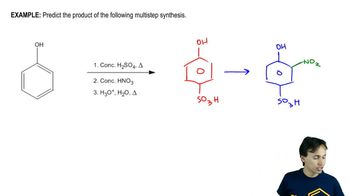
Multistep Synthesis

Multistep synthesis involves a series of chemical reactions that transform a starting material into a target molecule through intermediate compounds. Each step typically involves specific reactions such as substitutions, additions, or eliminations, and requires careful planning to ensure that the desired functional groups are introduced and that the overall yield is maximized.
Recommended video:
Guided course
02:15
Multistep Synthesis

Reaction Mechanisms

Understanding reaction mechanisms is crucial for predicting the outcomes of chemical reactions. A mechanism outlines the step-by-step process of how reactants convert to products, including the formation and breaking of bonds. Familiarity with common mechanisms, such as nucleophilic substitutions or electrophilic additions, helps in designing effective synthetic routes.
Recommended video:
Guided course
02:16
Heck Reaction Mechanism

Functional Group Transformations

Functional group transformations refer to the chemical reactions that convert one functional group into another. This concept is essential in organic synthesis, as it allows chemists to modify the structure and reactivity of molecules. Recognizing which reactions can achieve specific transformations is key to successfully designing a synthesis pathway for the target molecule.
Recommended video:
Guided course
02:36
Identifying Functional Groups