Ch. 9 - Substitution and Elimination Reactions of Alkyl Halides
Bruice - Organic Chemistry 8th Edition
Bruice8th EditionOrganic ChemistryISBN: 9780135213711Not the one you use?Change textbook
Chapter 10, Problem 67c

What product is formed when 1-bromopropane reacts with each of the following nucleophiles?
c. CH3S

Verified step by step guidance
1
Identify the type of reaction: This is a nucleophilic substitution reaction, where the nucleophile (CH3S−) will attack the electrophilic carbon in 1-bromopropane, displacing the bromine atom.
Analyze the substrate: 1-bromopropane is a primary alkyl halide, which typically undergoes an SN2 mechanism due to the lack of steric hindrance around the electrophilic carbon.
Understand the nucleophile: CH3S− is a strong nucleophile because sulfur is less electronegative than oxygen, making it more polarizable and better at donating its lone pair of electrons.
Describe the mechanism: In the SN2 mechanism, the nucleophile (CH3S−) attacks the carbon bonded to the bromine atom from the opposite side (backside attack), leading to the simultaneous displacement of the bromine atom as a leaving group.
Write the product: The nucleophile (CH3S−) replaces the bromine atom, forming the product CH3CH2CH2SCH3 (propyl methyl sulfide).

Verified video answer for a similar problem:

This video solution was recommended by our tutors as helpful for the problem above.
Video duration:
3m
Was this helpful?

Key Concepts

Here are the essential concepts you must grasp in order to answer the question correctly.

Nucleophilic Substitution

Nucleophilic substitution is a fundamental reaction in organic chemistry where a nucleophile replaces a leaving group in a molecule. In this context, 1-bromopropane, which contains a bromine leaving group, can undergo substitution when reacted with a nucleophile like CH3S−. The mechanism can follow either an SN1 or SN2 pathway, depending on the structure of the substrate and the nucleophile's strength.
Recommended video:
Guided course
01:47
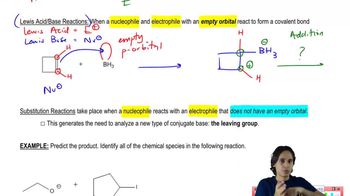
Nucleophiles and Electrophiles can react in Substitution Reactions.

Nucleophiles

Nucleophiles are species that donate an electron pair to form a chemical bond in a reaction. They are typically negatively charged or neutral molecules with lone pairs of electrons. In this case, CH3S− is a strong nucleophile due to the presence of a sulfur atom, which has a high electron density, making it effective in attacking the electrophilic carbon in 1-bromopropane.
Recommended video:
Guided course
08:27
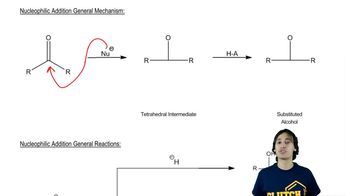
Nucleophilic Addition

Product Formation

The product formed from the reaction of 1-bromopropane with CH3S− is propyl thioether (CH3CH2CH2SCH3). This occurs as the nucleophile attacks the carbon atom bonded to the bromine, displacing the bromine atom and forming a new C-S bond. Understanding the nature of the product is crucial for predicting the outcome of nucleophilic substitution reactions.
Recommended video:
Guided course
11:07
Bridged-Products