c. Determine the critical values for a two-tailed test of a population mean at the α = 0.01 level of significance based on a sample size of n = 33.
Verified step by step guidance
1
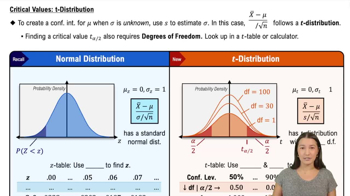
Identify the significance level \( \alpha = 0.01 \) and note that the test is two-tailed. This means the total \( \alpha \) is split equally between the two tails of the distribution, so each tail has an area of \( \frac{\alpha}{2} = 0.005 \).
Determine the degrees of freedom for the test. Since the sample size \( n = 33 \), the degrees of freedom \( df = n - 1 = 32 \).
Because the population standard deviation is unknown and the sample size is less than 30 (or close to it), use the \( t \)-distribution to find the critical values rather than the normal distribution.
Look up the critical \( t \)-values in the \( t \)-distribution table or use statistical software to find the values corresponding to \( df = 32 \) and a cumulative probability of \( 1 - \frac{\alpha}{2} = 0.995 \) for the upper tail. The critical values will be symmetric, so one will be positive and the other negative.
Express the critical values as \( \pm t_{\frac{\alpha}{2}, df} \), which represent the cutoff points beyond which the null hypothesis would be rejected in a two-tailed test.
Verified video answer for a similar problem:
This video solution was recommended by our tutors as helpful for the problem above
Video duration:
4m
Play a video:
0 Comments
Key Concepts
Here are the essential concepts you must grasp in order to answer the question correctly.
Two-Tailed Test
A two-tailed test evaluates whether a population parameter is significantly different from a hypothesized value in either direction. It splits the significance level α equally between the two tails of the distribution, testing for deviations both above and below the mean.
Critical values are the cutoff points on the test distribution that define the rejection regions for the null hypothesis. For a given α, these values mark the boundaries beyond which the test statistic indicates a statistically significant result.
When the population standard deviation is unknown and the sample size is small (n < 30 or close), the t-distribution is used instead of the normal distribution. Degrees of freedom, calculated as n - 1, determine the shape of the t-distribution and the critical values for hypothesis testing.