Back
Back
Problem 12.1.1a
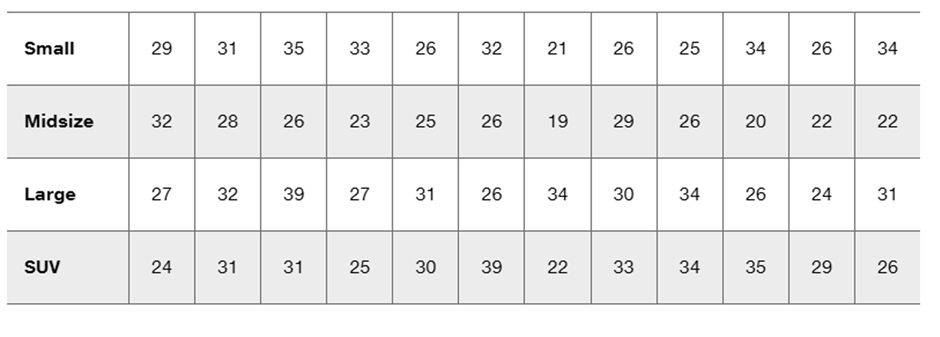
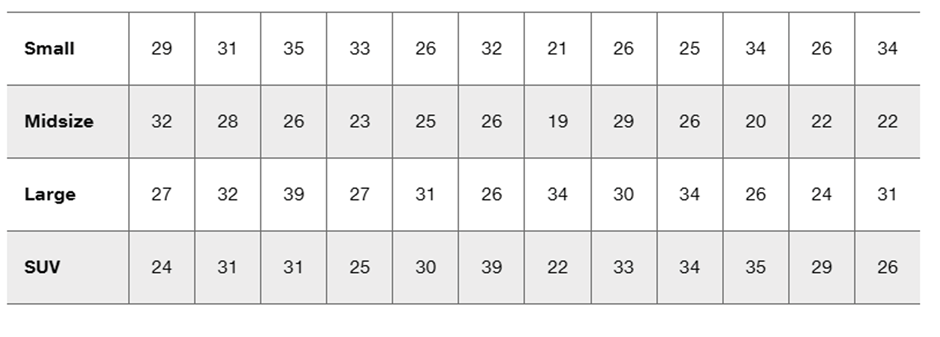
In Exercises 1–4, use the following listed measured amounts of chest compression (mm) from car crash tests (from Data Set 35 “Car Data” in Appendix B). Also shown are the SPSS results from analysis of variance. Assume that we plan to use a 0.05 significance level to test the claim that the different car sizes have the same mean amount of chest compression.
Anova
a. What characteristic of the data above indicates that we should use one-way analysis of variance?
Problem 12.2.11a
Transformations of Data Example 1 illustrated the use of two-way ANOVA to analyze the sample data in Table 12-3. How are the results affected in each of the following cases?
a. The same constant is added to each sample value.
Problem 12.1.3a
Interaction
a. What is an interaction between two factors?
Problem 12.1.18b
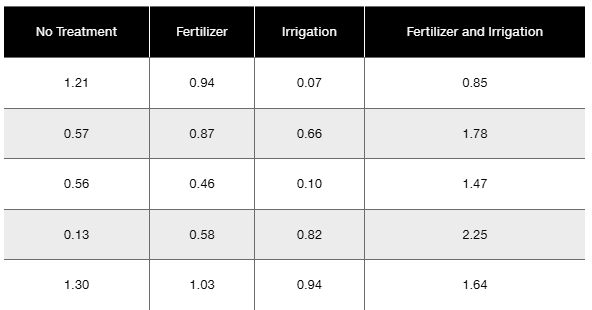
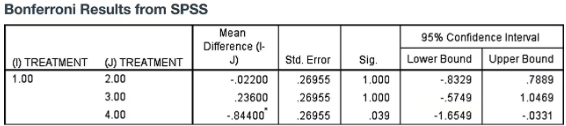
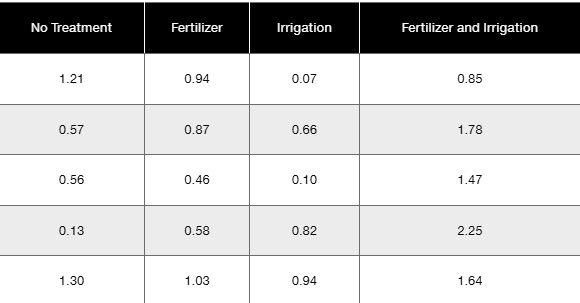
Bonferroni Test Shown below are weights (kg) of poplar trees obtained from trees planted in a rich and moist region. The trees were given different treatments identified in the table below. The data are from a study conducted by researchers at Pennsylvania State University and were provided by Minitab, Inc. Also shown are partial results from using the Bonferroni test with the sample data.
b. What do the displayed Bonferroni SPSS results tell us?
Problem 12.2.11b
Transformations of Data Example 1 illustrated the use of two-way ANOVA to analyze the sample data in Table 12-3. How are the results affected in each of the following cases?
b. Each sample value is multiplied by the same nonzero constant.
Problem 12.1.1b
In Exercises 1–4, use the following listed measured amounts of chest compression (mm) from car crash tests (from Data Set 35 “Car Data” in Appendix B). Also shown are the SPSS results from analysis of variance. Assume that we plan to use a 0.05 significance level to test the claim that the different car sizes have the same mean amount of chest compression.
Anova
b. If the objective is to test the claim that the four car sizes have the same mean chest compression, why is the method referred to as analysis of variance?
Problem 12.1.3b
Interaction
b. In general, when using two-way analysis of variance, if we find that there is an interaction effect, how does that affect the procedure?
Problem 12.2.3c
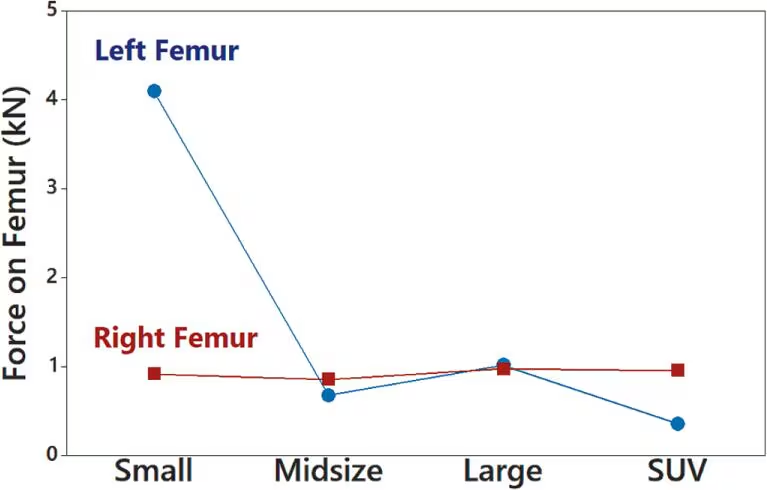
c. Shown below is an interaction graph constructed from the data in Exercise 1. What does the graph suggest?
Problem 12.c.1d
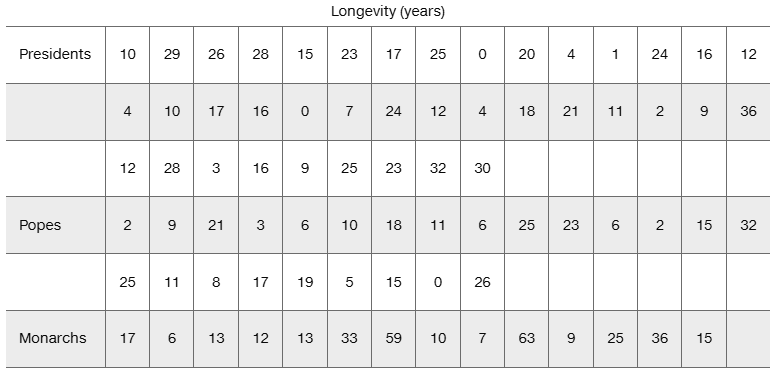
In Exercises 1–5, refer to the following list of numbers of years that deceased U.S. presidents, popes, and British monarchs lived after their inauguration, election, or coronation, respectively. (As of this writing, the last president is George H. W. Bush, the last pope is John Paul II, and the last British monarch is George VI.) Assume that the data are samples from larger populations.
[Image]
Exploring the Data Include appropriate units in all answers.
d. Are there any obvious outliers?
Problem 12.2.11c
Transformations of Data Example 1 illustrated the use of two-way ANOVA to analyze the sample data in Table 12-3. How are the results affected in each of the following cases?
c. The format of the table is transposed so that the row and column factors are interchanged.
Problem 12.1.18c
Bonferroni Test Shown below are weights (kg) of poplar trees obtained from trees planted in a rich and moist region. The trees were given different treatments identified in the table below. The data are from a study conducted by researchers at Pennsylvania State University and were provided by Minitab, Inc. Also shown are partial results from using the Bonferroni test with the sample data.
c. Use the Bonferroni test procedure with a 0.05 significance level to test for a significant difference between the mean amount of the irrigation treatment group and the group treated with both fertilizer and irrigation. Identify the test statistic and either the P-value or critical values. What do the results indicate?
Problem 12.2.11d
Transformations of Data Example 1 illustrated the use of two-way ANOVA to analyze the sample data in Table 12-3. How are the results affected in each of the following cases?
d. The first sample value in the first cell is changed so that it becomes an outlier.