Find the dot product for each pair of vectors. 4i, 5i - 9j
Verified step by step guidance
1
Identify the given vectors. The first vector is \(\vec{A} = 4\mathbf{i}\) and the second vector is \(\vec{B} = 5\mathbf{i} - 9\mathbf{j}\).
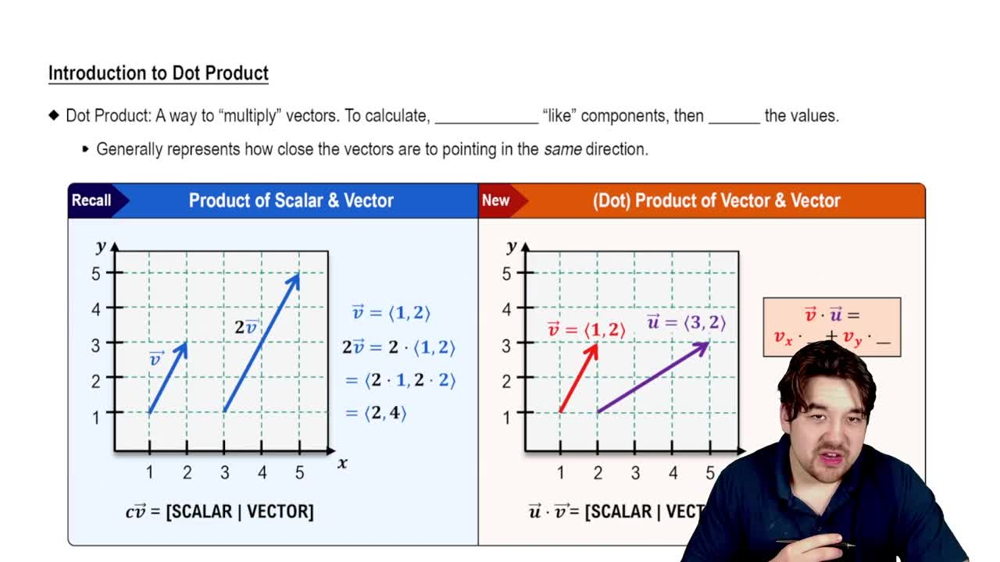
Recall the formula for the dot product of two vectors \(\vec{A} = a_1\mathbf{i} + a_2\mathbf{j}\) and \(\vec{B} = b_1\mathbf{i} + b_2\mathbf{j}\):
\(\vec{A} \cdot \vec{B} = a_1 b_1 + a_2 b_2\).
Extract the components of each vector: For \(\vec{A}\), \(a_1 = 4\) and \(a_2 = 0\) (since there is no \(\mathbf{j}\) component). For \(\vec{B}\), \(b_1 = 5\) and \(b_2 = -9\).
Substitute the components into the dot product formula:
\(\vec{A} \cdot \vec{B} = (4)(5) + (0)(-9)\).
Simplify the expression by multiplying and adding the terms to find the dot product.
Verified video answer for a similar problem:
This video solution was recommended by our tutors as helpful for the problem above
Play a video:
0 Comments
Key Concepts
Here are the essential concepts you must grasp in order to answer the question correctly.
Vector Components and Notation
Vectors are often expressed in terms of unit vectors i, j, and k, representing the x, y, and z directions respectively. Understanding how to identify and separate these components is essential for performing operations like the dot product.
The dot product of two vectors is a scalar obtained by multiplying corresponding components and summing the results. For vectors in two dimensions, it is calculated as (x1 * x2) + (y1 * y2), which measures the extent to which the vectors point in the same direction.
The dot product is commutative and relates to the angle between vectors through the formula A · B = |A||B|cosθ. It is used to find projections, angles, and to determine orthogonality between vectors.

 Verified step by step guidance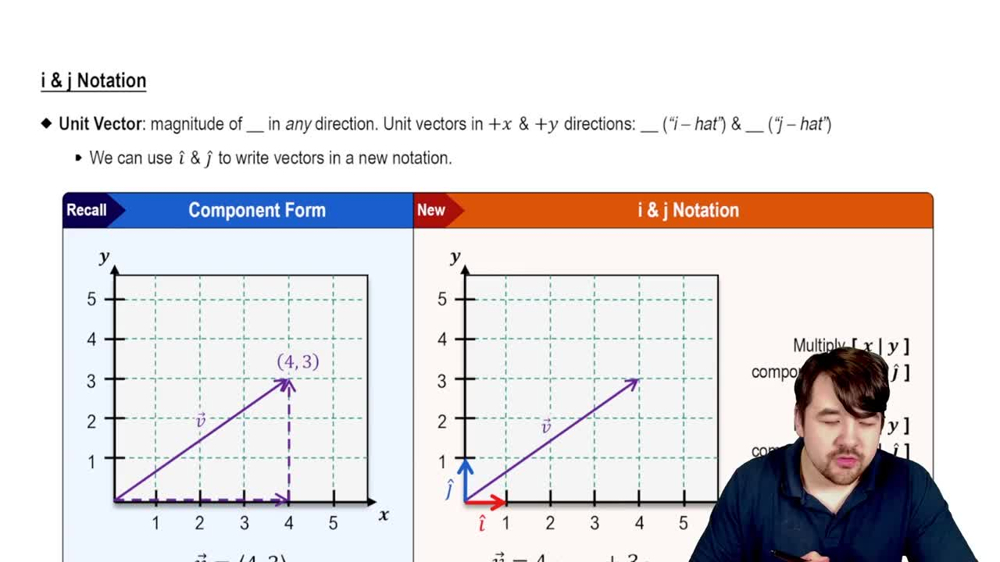
 06:01
06:01