Be sure that you've familiarized yourself with the second set of formulas presented in this section by working C5–C8 in the Concept and Vocabulary Check. In Exercises 9–22, express each sum or difference as a product. If possible, find this product's exact value. cos 75° ﹣ cos 15°
Table of contents
- 0. Review of College Algebra4h 45m
- 1. Measuring Angles40m
- 2. Trigonometric Functions on Right Triangles2h 5m
- 3. Unit Circle1h 19m
- 4. Graphing Trigonometric Functions1h 19m
- 5. Inverse Trigonometric Functions and Basic Trigonometric Equations1h 41m
- 6. Trigonometric Identities and More Equations2h 34m
- 7. Non-Right Triangles1h 38m
- 8. Vectors2h 25m
- 9. Polar Equations2h 5m
- 10. Parametric Equations1h 6m
- 11. Graphing Complex Numbers1h 7m
6. Trigonometric Identities and More Equations
Introduction to Trigonometric Identities
Problem 5.RE.40
Textbook Question
Use the given information to find each of the following.
sin y, given cos 2y = -1/3 , π/2 < y < π
Verified step by step guidance1
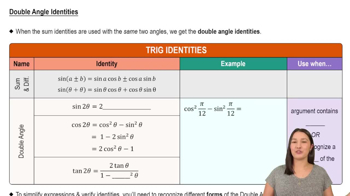
Recall the double-angle identity for cosine: \(\cos(2y) = 2\cos^2(y) - 1\).
Use the given value \(\cos(2y) = -\frac{1}{3}\) and substitute it into the identity: \(-\frac{1}{3} = 2\cos^2(y) - 1\).
Solve the equation for \(\cos^2(y)\): add 1 to both sides to get \(\frac{2}{3} = 2\cos^2(y)\), then divide both sides by 2 to find \(\cos^2(y) = \frac{1}{3}\).
Find \(\cos(y)\) by taking the square root: \(\cos(y) = \pm \sqrt{\frac{1}{3}} = \pm \frac{1}{\sqrt{3}}\). Determine the correct sign of \(\cos(y)\) using the interval \(\frac{\pi}{2} < y < \pi\), where cosine is negative.
Use the Pythagorean identity \(\sin^2(y) + \cos^2(y) = 1\) to find \(\sin(y)\): substitute \(\cos^2(y) = \frac{1}{3}\), then solve for \(\sin(y)\), considering the sign of \(\sin(y)\) in the given interval.
Verified video answer for a similar problem:This video solution was recommended by our tutors as helpful for the problem above
Play a video:
0 Comments
Key Concepts
Here are the essential concepts you must grasp in order to answer the question correctly.
Double-Angle Identity for Cosine
The double-angle identity states that cos(2y) = 2cos²(y) - 1 or cos(2y) = 1 - 2sin²(y). This identity allows us to express cos(2y) in terms of sin(y) or cos(y), which is essential for finding sin(y) when cos(2y) is known.
Recommended video:
Double Angle Identities
Sign of Trigonometric Functions in Quadrants
The value of sin(y) depends on the quadrant where angle y lies. Since π/2 < y < π, y is in the second quadrant where sine is positive and cosine is negative. This information helps determine the correct sign of sin(y) after calculation.
Recommended video:
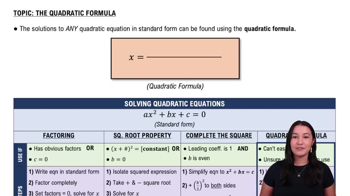
Quadratic Formula
Pythagorean Identity
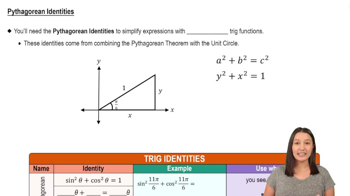
The Pythagorean identity, sin²(y) + cos²(y) = 1, relates sine and cosine of the same angle. It is useful for finding sin(y) once cos(y) is determined or vice versa, ensuring the values satisfy this fundamental trigonometric relationship.
Recommended video:
Pythagorean Identities
Related Videos
Related Practice
Textbook Question
636
views
