Starting at point X, a ship sails 15.5 km on a bearing of 200°, then turns and sails 2.4 km on a bearing of 320°. Find the distance of the ship from point X.
Table of contents
- 0. Review of College Algebra4h 45m
- 1. Measuring Angles40m
- 2. Trigonometric Functions on Right Triangles2h 5m
- 3. Unit Circle1h 19m
- 4. Graphing Trigonometric Functions1h 19m
- 5. Inverse Trigonometric Functions and Basic Trigonometric Equations1h 41m
- 6. Trigonometric Identities and More Equations2h 34m
- 7. Non-Right Triangles1h 38m
- 8. Vectors2h 25m
- 9. Polar Equations2h 5m
- 10. Parametric Equations1h 6m
- 11. Graphing Complex Numbers1h 7m
8. Vectors
Geometric Vectors
Problem 7
Textbook Question
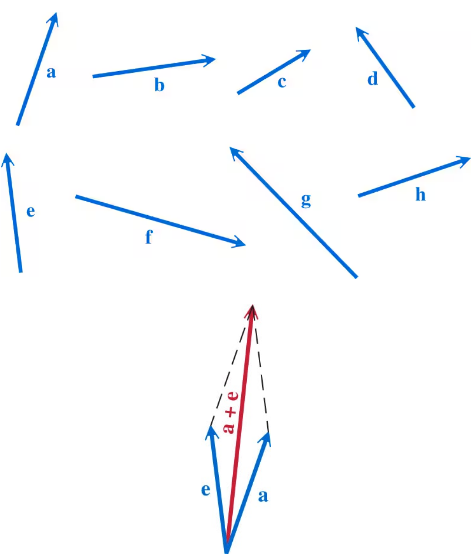
CONCEPT PREVIEW Refer to vectors a through h below. Make a copy or a sketch of each vector, and then draw a sketch to represent each of the following. For example, find a + e by placing a and e so that their initial points coincide. Then use the parallelogram rule to find the resultant, as shown in the figure on the right.

2c
Verified step by step guidance1
Identify the vector labeled \( c \) from the given set of vectors. Make a clear sketch of this vector, noting its direction and magnitude.
Since the problem asks for \( 2c \), understand that this means scaling the vector \( c \) by a factor of 2. This involves doubling the length of vector \( c \) while keeping its direction the same.
On your sketch, draw the vector \( c \) starting from an initial point. Then, from the tip (head) of this vector, draw another vector identical in length and direction to \( c \).
The resultant vector \( 2c \) is the vector from the initial point of the first \( c \) to the tip of the second \( c \). This represents the sum \( c + c = 2c \).
Label the resultant vector \( 2c \) on your sketch to clearly show the doubled vector, and verify that its length is twice that of the original vector \( c \) and that it points in the same direction.
Verified video answer for a similar problem:This video solution was recommended by our tutors as helpful for the problem above
Play a video:
0 Comments
Key Concepts
Here are the essential concepts you must grasp in order to answer the question correctly.
Vector Addition
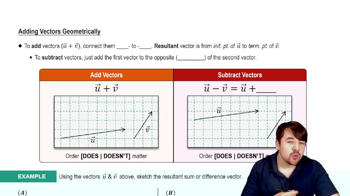
Vector addition involves combining two or more vectors to find a resultant vector. This is done by placing the initial point of one vector at the terminal point of another and then drawing the vector from the start of the first to the end of the last. It is essential for understanding how to combine vectors like a + e.
Recommended video:
Adding Vectors Geometrically
Parallelogram Rule
The parallelogram rule is a graphical method to add two vectors. By placing the vectors so their tails coincide, you complete a parallelogram with these vectors as adjacent sides. The diagonal of the parallelogram from the common tail point represents the resultant vector.
Recommended video:
Sine, Cosine, & Tangent of 30°, 45°, & 60°
Scalar Multiplication of Vectors
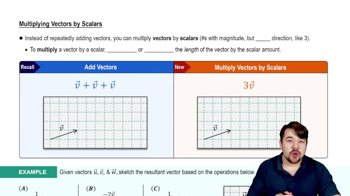
Scalar multiplication involves multiplying a vector by a scalar (a real number), which changes the vector's magnitude without altering its direction unless the scalar is negative. For example, 2c means doubling the length of vector c while keeping its direction the same.
Recommended video:
Multiplying Vectors By Scalars
Related Videos
Related Practice
Textbook Question
853
views