Starting at point A, a ship sails 18.5 km on a bearing of 189°, then turns and sails 47.8 km on a bearing of 317°. Find the distance of the ship from point A.
Table of contents
- 0. Review of College Algebra4h 45m
- 1. Measuring Angles40m
- 2. Trigonometric Functions on Right Triangles2h 5m
- 3. Unit Circle1h 19m
- 4. Graphing Trigonometric Functions1h 19m
- 5. Inverse Trigonometric Functions and Basic Trigonometric Equations1h 41m
- 6. Trigonometric Identities and More Equations2h 34m
- 7. Non-Right Triangles1h 38m
- 8. Vectors2h 25m
- 9. Polar Equations2h 5m
- 10. Parametric Equations1h 6m
- 11. Graphing Complex Numbers1h 7m
8. Vectors
Geometric Vectors
Problem 41a
Textbook Question
Given vectors u and v, find: 2u.
u = 2i, v = i + j
Verified step by step guidance1
Identify the given vector \( \mathbf{u} \). Here, \( \mathbf{u} = 2\mathbf{i} \), which means the vector has a component of 2 in the \( \mathbf{i} \) (x) direction and 0 in the \( \mathbf{j} \) (y) direction.
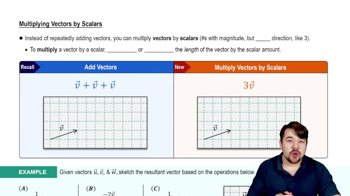
Understand that multiplying a vector by a scalar (in this case, 2) means multiplying each component of the vector by that scalar.
Write the scalar multiplication operation: \( 2\mathbf{u} = 2 \times (2\mathbf{i}) \).
Multiply the scalar 2 by each component of \( \mathbf{u} \). Since \( \mathbf{u} = 2\mathbf{i} + 0\mathbf{j} \), this becomes \( 2 \times 2\mathbf{i} + 2 \times 0\mathbf{j} \).
Simplify the expression to get the resulting vector \( 2\mathbf{u} \).
Verified video answer for a similar problem:This video solution was recommended by our tutors as helpful for the problem above
Play a video:
0 Comments
Key Concepts
Here are the essential concepts you must grasp in order to answer the question correctly.
Vector Representation in Component Form
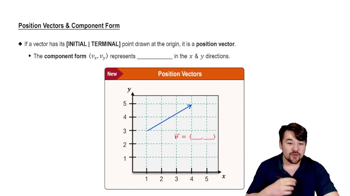
Vectors can be expressed as a combination of unit vectors along coordinate axes, such as i and j in two dimensions. For example, u = 2i means the vector has a magnitude of 2 units along the x-axis and zero along the y-axis.
Recommended video:
Position Vectors & Component Form
Scalar Multiplication of Vectors
Multiplying a vector by a scalar involves multiplying each component of the vector by that scalar. This operation changes the vector's magnitude but not its direction unless the scalar is negative, which reverses the direction.
Recommended video:
Multiplying Vectors By Scalars
Vector Addition and Subtraction
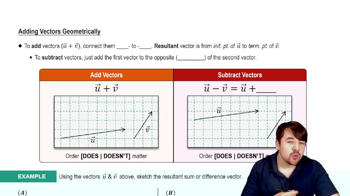
Vectors can be added or subtracted by combining their corresponding components. Although not directly required here, understanding vector addition helps in comprehending vector operations and their geometric interpretations.
Recommended video:
Adding Vectors Geometrically
Related Videos
Related Practice
Textbook Question
1036
views