A crate is supported by two ropes. One rope makes an angle of 46° 20′ with the horizontal and has a tension of 89.6 lb on it. The other rope is horizontal. Find the weight of the crate and the tension in the horizontal rope.
Table of contents
- 0. Review of College Algebra4h 45m
- 1. Measuring Angles40m
- 2. Trigonometric Functions on Right Triangles2h 5m
- 3. Unit Circle1h 19m
- 4. Graphing Trigonometric Functions1h 19m
- 5. Inverse Trigonometric Functions and Basic Trigonometric Equations1h 41m
- 6. Trigonometric Identities and More Equations2h 34m
- 7. Non-Right Triangles1h 38m
- 8. Vectors2h 25m
- 9. Polar Equations2h 5m
- 10. Parametric Equations1h 6m
- 11. Graphing Complex Numbers1h 7m
8. Vectors
Geometric Vectors
Problem 67
Textbook Question
Let u = 〈-2, 1〉, v = 〈3, 4〉, and w = 〈-5, 12〉. Evaluate each expression.
(3u) • v
Verified step by step guidance1
Recall that the dot product of two vectors \( \mathbf{a} = \langle a_1, a_2 \rangle \) and \( \mathbf{b} = \langle b_1, b_2 \rangle \) is given by the formula:
\[ \mathbf{a} \cdot \mathbf{b} = a_1 b_1 + a_2 b_2 \]
First, calculate the vector \( 3\mathbf{u} \) by multiplying each component of \( \mathbf{u} = \langle -2, 1 \rangle \) by 3:
\[ 3\mathbf{u} = \langle 3 \times (-2), 3 \times 1 \rangle = \langle -6, 3 \rangle \]
Now, use the dot product formula to find \( (3\mathbf{u}) \cdot \mathbf{v} \), where \( \mathbf{v} = \langle 3, 4 \rangle \):
\[ (3\mathbf{u}) \cdot \mathbf{v} = (-6)(3) + (3)(4) \]
Simplify the expression by performing the multiplications inside the dot product:
\[ (-6)(3) + (3)(4) = -18 + 12 \]
Finally, add the results to get the value of the dot product:
\[ -18 + 12 \]
Verified video answer for a similar problem:This video solution was recommended by our tutors as helpful for the problem above
Play a video:
0 Comments
Key Concepts
Here are the essential concepts you must grasp in order to answer the question correctly.
Vector Scalar Multiplication
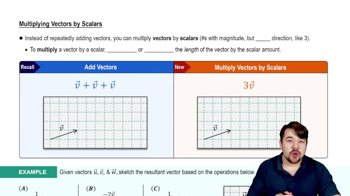
Scalar multiplication involves multiplying each component of a vector by a scalar (a real number). For example, multiplying vector u = 〈-2, 1〉 by 3 results in 〈-6, 3〉. This operation scales the vector's magnitude without changing its direction.
Recommended video:
Multiplying Vectors By Scalars
Dot Product of Vectors
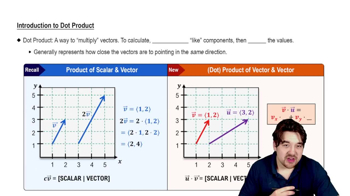
The dot product of two vectors is the sum of the products of their corresponding components. For vectors a = 〈a1, a2〉 and b = 〈b1, b2〉, the dot product is a1*b1 + a2*b2. It results in a scalar and measures the extent to which the vectors point in the same direction.
Recommended video:
Introduction to Dot Product
Properties of Dot Product with Scalar Multiplication
The dot product is distributive over scalar multiplication, meaning (c*u) • v = c*(u • v), where c is a scalar. This property allows simplification by factoring out scalars before computing the dot product, making calculations more efficient.
Recommended video:
Introduction to Dot Product
Related Videos
Related Practice
Textbook Question
794
views
