A luxury liner leaves port on a bearing of 110.0° and travels 8.8 mi. It then turns due west and travels 2.4 mi. How far is the liner from port, and what is its bearing from port?
Table of contents
- 0. Review of College Algebra4h 45m
- 1. Measuring Angles40m
- 2. Trigonometric Functions on Right Triangles2h 5m
- 3. Unit Circle1h 19m
- 4. Graphing Trigonometric Functions1h 19m
- 5. Inverse Trigonometric Functions and Basic Trigonometric Equations1h 41m
- 6. Trigonometric Identities and More Equations2h 34m
- 7. Non-Right Triangles1h 38m
- 8. Vectors2h 25m
- 9. Polar Equations2h 5m
- 10. Parametric Equations1h 6m
- 11. Graphing Complex Numbers1h 7m
8. Vectors
Geometric Vectors
Problem 69
Textbook Question
Let u = 〈-2, 1〉, v = 〈3, 4〉, and w = 〈-5, 12〉. Evaluate each expression.
u • v - u • w
Verified step by step guidance1
Recall that the dot product of two vectors \( \mathbf{a} = \langle a_1, a_2 \rangle \) and \( \mathbf{b} = \langle b_1, b_2 \rangle \) is given by the formula:
\[ \mathbf{a} \cdot \mathbf{b} = a_1 \times b_1 + a_2 \times b_2 \]
Calculate the dot product \( \mathbf{u} \cdot \mathbf{v} \) using the components of \( \mathbf{u} = \langle -2, 1 \rangle \) and \( \mathbf{v} = \langle 3, 4 \rangle \):
\[ \mathbf{u} \cdot \mathbf{v} = (-2) \times 3 + 1 \times 4 \]
Calculate the dot product \( \mathbf{u} \cdot \mathbf{w} \) using the components of \( \mathbf{u} = \langle -2, 1 \rangle \) and \( \mathbf{w} = \langle -5, 12 \rangle \):
\[ \mathbf{u} \cdot \mathbf{w} = (-2) \times (-5) + 1 \times 12 \]
Substitute the results from the two dot products into the expression \( \mathbf{u} \cdot \mathbf{v} - \mathbf{u} \cdot \mathbf{w} \) to get:
\[ (\mathbf{u} \cdot \mathbf{v}) - (\mathbf{u} \cdot \mathbf{w}) \]
Simplify the expression by performing the arithmetic operations to find the final value of \( \mathbf{u} \cdot \mathbf{v} - \mathbf{u} \cdot \mathbf{w} \).
Verified video answer for a similar problem:This video solution was recommended by our tutors as helpful for the problem above
Play a video:
0 Comments
Key Concepts
Here are the essential concepts you must grasp in order to answer the question correctly.
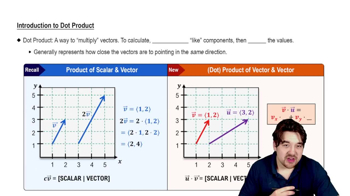
Dot Product of Vectors
The dot product is an algebraic operation that takes two equal-length sequences of numbers (vectors) and returns a single number. It is calculated by multiplying corresponding components and summing the results. For vectors u = 〈u1, u2〉 and v = 〈v1, v2〉, the dot product is u • v = u1*v1 + u2*v2.
Recommended video:
Introduction to Dot Product
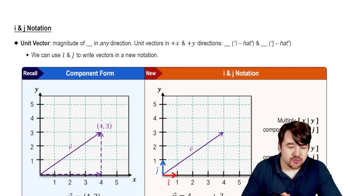
Vector Components and Notation
Vectors in two dimensions are represented as ordered pairs 〈x, y〉, where x and y are components along the horizontal and vertical axes. Understanding this notation is essential for performing operations like addition, subtraction, and dot product on vectors.
Recommended video:
i & j Notation
Properties of the Dot Product
The dot product is distributive over vector addition and subtraction, meaning u • (v - w) = u • v - u • w. This property allows simplification of expressions involving multiple dot products, facilitating easier calculation and understanding of vector relationships.
Recommended video:
Introduction to Dot Product
Related Videos
Related Practice
Textbook Question
806
views