Standing on one bank of a river flowing north, Mark notices a tree on the opposite bank at a bearing of 115.45°. Lisa is on the same bank as Mark, but 428.3 m away. She notices that the bearing of the tree is 45.47°. The two banks are parallel. What is the distance across the river?
Table of contents
- 0. Review of College Algebra4h 45m
- 1. Measuring Angles40m
- 2. Trigonometric Functions on Right Triangles2h 5m
- 3. Unit Circle1h 19m
- 4. Graphing Trigonometric Functions1h 19m
- 5. Inverse Trigonometric Functions and Basic Trigonometric Equations1h 41m
- 6. Trigonometric Identities and More Equations2h 34m
- 7. Non-Right Triangles1h 38m
- 8. Vectors2h 25m
- 9. Polar Equations2h 5m
- 10. Parametric Equations1h 6m
- 11. Graphing Complex Numbers1h 7m
7. Non-Right Triangles
Law of Sines
Problem 51
Textbook Question
Find the area of each triangle ABC.
A = 42.5°, b = 13.6 m, c = 10.1 m
Verified step by step guidance1
Identify the given elements of the triangle: angle \(A = 42.5^\circ\), side \(b = 13.6\) m, and side \(c = 10.1\) m. We need to find the area of triangle \(ABC\).
Recall the formula for the area of a triangle when two sides and the included angle are known: \(\text{Area} = \frac{1}{2} \times b \times c \times \sin(A)\).
Substitute the known values into the formula: \(\text{Area} = \frac{1}{2} \times 13.6 \times 10.1 \times \sin(42.5^\circ)\).
Calculate \(\sin(42.5^\circ)\) using a calculator or trigonometric table to find the sine of the given angle.
Multiply the values together: half of the product of sides \(b\) and \(c\), then multiply by \(\sin(42.5^\circ)\) to find the area of the triangle.
Verified video answer for a similar problem:This video solution was recommended by our tutors as helpful for the problem above
Play a video:
0 Comments
Key Concepts
Here are the essential concepts you must grasp in order to answer the question correctly.
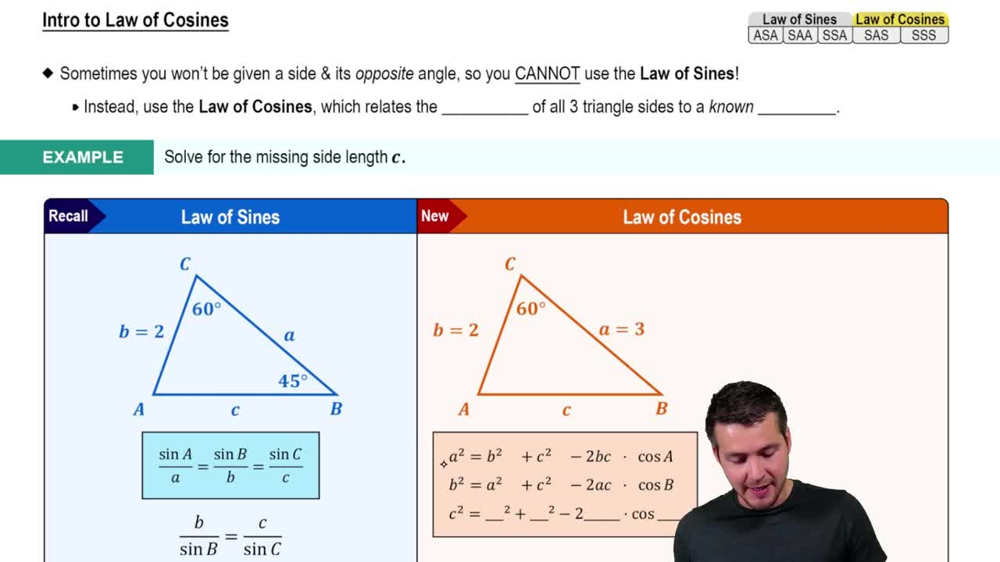
Law of Cosines
The Law of Cosines relates the lengths of the sides of a triangle to the cosine of one of its angles. It is useful for finding an unknown side or angle when two sides and the included angle are known. The formula is c² = a² + b² - 2ab cos(C), helping to determine missing elements in non-right triangles.
Recommended video:
Intro to Law of Cosines
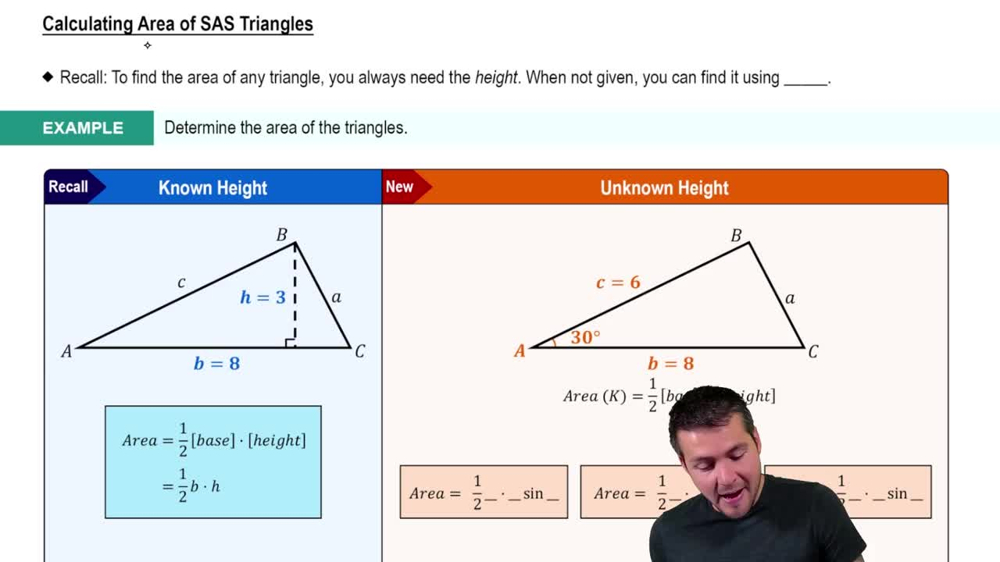
Area of a Triangle Using Two Sides and Included Angle
The area of a triangle can be calculated using two sides and the included angle with the formula: Area = 1/2 * b * c * sin(A). This method is especially useful when the height is unknown but two sides and the angle between them are given, allowing direct computation of the area.
Recommended video:
Calculating Area of SAS Triangles
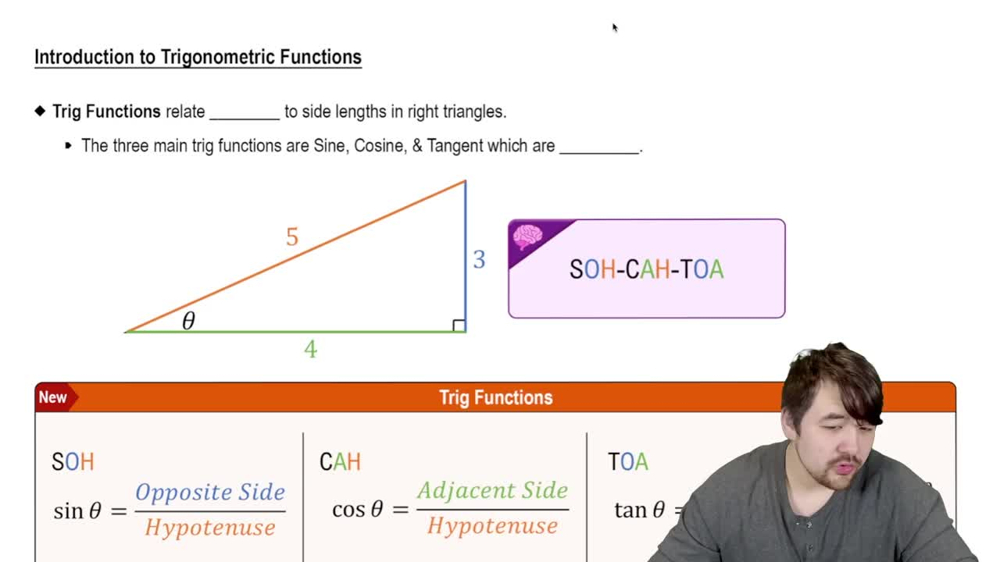
Sine Function in Trigonometry
The sine function relates an angle of a triangle to the ratio of the length of the opposite side over the hypotenuse in a right triangle. In non-right triangles, sine is used in formulas like the area formula and the Law of Sines, making it essential for solving problems involving angles and side lengths.
Recommended video:
Introduction to Trigonometric Functions
Related Videos
Related Practice
Textbook Question
695
views
