Find all values of θ, if θ is in the interval [0°, 360°) and has the given function value. See Example 6. √3 cot θ = - —— 3
Verified step by step guidance
1
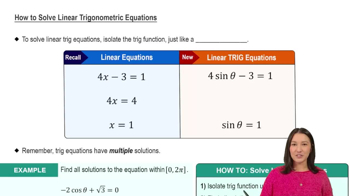
Start by writing down the given equation: \(\cot \theta = -\frac{\sqrt{3}}{3}\).
Recall that \(\cot \theta = \frac{1}{\tan \theta}\), so rewrite the equation as \(\frac{1}{\tan \theta} = -\frac{\sqrt{3}}{3}\), which implies \(\tan \theta = -\frac{3}{\sqrt{3}}\).
Simplify \(\tan \theta = -\frac{3}{\sqrt{3}}\) to get \(\tan \theta = -\sqrt{3}\).
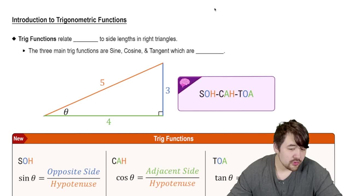
Determine the reference angle where \(\tan \theta = \sqrt{3}\). From the unit circle or common angles, \(\tan 60^\circ = \sqrt{3}\), so the reference angle is \(60^\circ\).
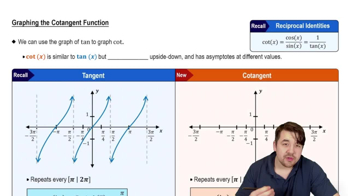
Since \(\tan \theta\) is negative, find all angles in the interval \([0^\circ, 360^\circ)\) where tangent is negative. Tangent is negative in the second and fourth quadrants, so the solutions are \(\theta = 180^\circ - 60^\circ\) and \(\theta = 360^\circ - 60^\circ\).
Verified video answer for a similar problem:
This video solution was recommended by our tutors as helpful for the problem above
Video duration:
3m
Play a video:
0 Comments
Key Concepts
Here are the essential concepts you must grasp in order to answer the question correctly.
Cotangent Function and Its Definition
Cotangent (cot θ) is the reciprocal of the tangent function, defined as cot θ = cos θ / sin θ. Understanding this relationship helps in converting cotangent values into sine and cosine ratios, which is essential for solving trigonometric equations.
Solving Trigonometric Equations in a Given Interval
When solving for θ within [0°, 360°), it is important to find all angles that satisfy the equation. This involves considering the periodicity of trigonometric functions and identifying all solutions in the specified range, including those in different quadrants.
Sign of Trigonometric Functions in Different Quadrants
The sign of cotangent depends on the signs of sine and cosine, which vary by quadrant. Cotangent is negative where sine and cosine have opposite signs, specifically in the second and fourth quadrants, guiding the selection of correct angle solutions.

 3:21 minutes
 Verified step by step guidance
 5:37
5:37