Find all values of θ, if θ is in the interval [0°, 360°) and has the given function value. See Example 6. √3 sin θ = - —— 2
Verified step by step guidance
1
Recognize that the equation is \( \sin \theta = -\frac{\sqrt{3}}{2} \). We need to find all angles \( \theta \) in the interval \( [0^\circ, 360^\circ) \) where the sine value equals \( -\frac{\sqrt{3}}{2} \).
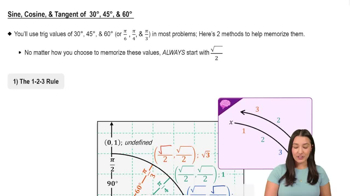
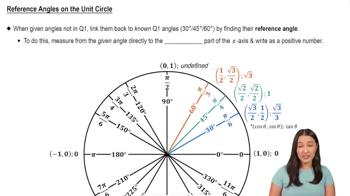
Recall the reference angle where \( \sin \theta = \frac{\sqrt{3}}{2} \) is \( 60^\circ \) because \( \sin 60^\circ = \frac{\sqrt{3}}{2} \). Since our sine value is negative, \( \theta \) must be in the quadrants where sine is negative.
Identify the quadrants where sine is negative: the third and fourth quadrants. So, the angles we seek are related to the reference angle \( 60^\circ \) but located in these quadrants.
Calculate the angles in the third and fourth quadrants by adding the reference angle to 180° and subtracting it from 360°, respectively. That is, \( \theta = 180^\circ + 60^\circ \) and \( \theta = 360^\circ - 60^\circ \).
Write the general solutions for \( \theta \) in the interval \( [0^\circ, 360^\circ) \) as \( \theta = 240^\circ \) and \( \theta = 300^\circ \).
Verified video answer for a similar problem:
This video solution was recommended by our tutors as helpful for the problem above
Video duration:
3m
Play a video:
0 Comments
Key Concepts
Here are the essential concepts you must grasp in order to answer the question correctly.
Unit Circle and Angle Measurement
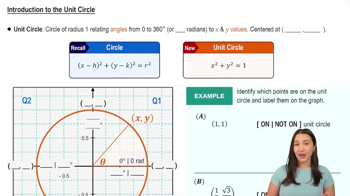
The unit circle is a circle with radius 1 centered at the origin, used to define trigonometric functions for all angles. Angles are measured in degrees or radians, and the sine of an angle corresponds to the y-coordinate of the point on the unit circle. Understanding the interval [0°, 360°) means considering one full rotation around the circle.
The sine function gives the ratio of the opposite side to the hypotenuse in a right triangle, or the y-coordinate on the unit circle. Knowing that sin θ = -√3/2 indicates the angle's sine value is negative, which occurs in the third and fourth quadrants where y-values are negative.
Reference angles are acute angles used to find sine values for angles in different quadrants. Since sine is negative in the third and fourth quadrants, you find the reference angle with positive sine √3/2 (which is 60°), then determine θ by adjusting for the correct quadrant within [0°, 360°).

 3:47 minutes
 Verified step by step guidance
 06:11
06:11