In Exercises 43–52, determine the amplitude, period, and phase shift of each function. Then graph one period of the function. y = −3 cos (2x − π/2)
Table of contents
- 0. Review of College Algebra4h 45m
- 1. Measuring Angles40m
- 2. Trigonometric Functions on Right Triangles2h 5m
- 3. Unit Circle1h 19m
- 4. Graphing Trigonometric Functions1h 19m
- 5. Inverse Trigonometric Functions and Basic Trigonometric Equations1h 41m
- 6. Trigonometric Identities and More Equations2h 34m
- 7. Non-Right Triangles1h 38m
- 8. Vectors2h 25m
- 9. Polar Equations2h 5m
- 10. Parametric Equations1h 6m
- 11. Graphing Complex Numbers1h 7m
4. Graphing Trigonometric Functions
Graphs of the Sine and Cosine Functions
Problem 1
Textbook Question
Determine the amplitude and period of each function. Then graph one period of the function. y = 3 sin 4x
Verified step by step guidance1
Identify the general form of the sine function, which is \(y = A \sin(Bx)\), where \(A\) represents the amplitude and \(B\) affects the period of the function.
Determine the amplitude by taking the absolute value of the coefficient in front of the sine function. In this case, the amplitude is \(|3|\).
Calculate the period using the formula \(\text{Period} = \frac{2\pi}{B}\), where \(B\) is the coefficient of \(x\) inside the sine function. Here, \(B = 4\).
Substitute \(B = 4\) into the period formula to express the period as \(\frac{2\pi}{4}\), which can be simplified but do not calculate the final value yet.
To graph one period of the function, plot the sine curve starting from \(x = 0\) to \(x = \frac{2\pi}{4}\), marking key points such as the maximum, minimum, and zeros based on the amplitude and period.
Verified video answer for a similar problem:This video solution was recommended by our tutors as helpful for the problem above
Video duration:
2mPlay a video:
0 Comments
Key Concepts
Here are the essential concepts you must grasp in order to answer the question correctly.
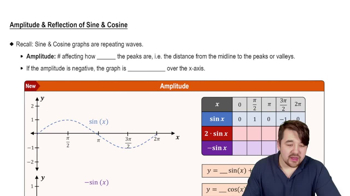
Amplitude of a Sine Function
The amplitude of a sine function is the absolute value of the coefficient in front of the sine term. It represents the maximum vertical distance from the midline (usually the x-axis) to the peak of the wave. For y = 3 sin 4x, the amplitude is 3, indicating the wave oscillates between -3 and 3.
Recommended video:
Amplitude and Reflection of Sine and Cosine
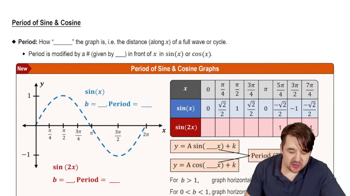
Period of a Sine Function
The period of a sine function is the length of one complete cycle along the x-axis. It is calculated by dividing 2π by the coefficient of x inside the sine function. For y = 3 sin 4x, the period is 2π/4 = π/2, meaning the function repeats every π/2 units.
Recommended video:
Period of Sine and Cosine Functions
Graphing One Period of a Sine Function
Graphing one period involves plotting the sine curve from 0 to the period length on the x-axis, showing key points such as the start, maximum, zero crossing, minimum, and end. For y = 3 sin 4x, graphing from 0 to π/2 captures one full wave oscillation between -3 and 3.
Recommended video:
Period of Sine and Cosine Functions
Related Videos
Related Practice
Textbook Question
527
views