In Exercises 17–22, let θ be an angle in standard position. Name the quadrant in which θ lies.sin θ < 0, cos θ < 0
Verified step by step guidance
1
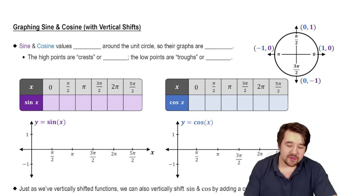
Recall that the sine function is negative in Quadrants III and IV.
Recall that the cosine function is negative in Quadrants II and III.
Identify the quadrant where both sine and cosine are negative.
Since both conditions are met in Quadrant III, conclude that θ lies in Quadrant III.
Verified video answer for a similar problem:
This video solution was recommended by our tutors as helpful for the problem above
Video duration:
2m
Play a video:
0 Comments
Key Concepts
Here are the essential concepts you must grasp in order to answer the question correctly.
Quadrants of the Coordinate Plane
The coordinate plane is divided into four quadrants based on the signs of the x (cosine) and y (sine) coordinates. Quadrant I has both sine and cosine positive, Quadrant II has sine positive and cosine negative, Quadrant III has both negative, and Quadrant IV has sine negative and cosine positive. Understanding these quadrants is essential for determining the location of an angle based on the signs of its trigonometric functions.
The sine and cosine functions are fundamental trigonometric functions that relate the angles of a right triangle to the ratios of its sides. Specifically, sine represents the ratio of the opposite side to the hypotenuse, while cosine represents the ratio of the adjacent side to the hypotenuse. The signs of these functions indicate the position of the angle in the coordinate plane, which is crucial for identifying the quadrant.
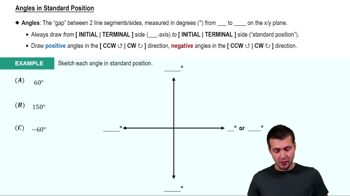
An angle is said to be in standard position when its vertex is at the origin of the coordinate plane and its initial side lies along the positive x-axis. The terminal side of the angle is determined by the angle's measure, and its position relative to the axes helps in identifying the quadrant. This concept is vital for analyzing the angle's trigonometric values and determining the quadrant based on those values.