In Exercises 23–34, find the exact value of each of the remaining trigonometric functions of θ.cos θ = -3/5, θ in quadrant III
Verified step by step guidance
1
Step 1: Understand the problem context. Since \( \cos \theta = -\frac{3}{5} \) and \( \theta \) is in quadrant III, we know that both sine and cosine are negative in this quadrant.
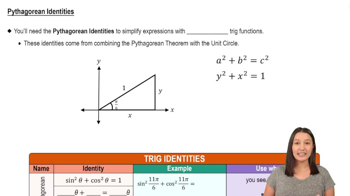
Step 2: Use the Pythagorean identity \( \sin^2 \theta + \cos^2 \theta = 1 \) to find \( \sin \theta \). Substitute \( \cos \theta = -\frac{3}{5} \) into the identity: \( \sin^2 \theta + \left(-\frac{3}{5}\right)^2 = 1 \).
Step 3: Simplify the equation: \( \sin^2 \theta + \frac{9}{25} = 1 \). Solve for \( \sin^2 \theta \) by subtracting \( \frac{9}{25} \) from both sides.
Step 4: Calculate \( \sin \theta \) by taking the square root of both sides. Remember, since \( \theta \) is in quadrant III, \( \sin \theta \) will be negative.
Step 5: Use the values of \( \sin \theta \) and \( \cos \theta \) to find the other trigonometric functions: \( \tan \theta = \frac{\sin \theta}{\cos \theta} \), \( \csc \theta = \frac{1}{\sin \theta} \), \( \sec \theta = \frac{1}{\cos \theta} \), and \( \cot \theta = \frac{1}{\tan \theta} \).
Verified video answer for a similar problem:
This video solution was recommended by our tutors as helpful for the problem above
Video duration:
7m
Play a video:
0 Comments
Key Concepts
Here are the essential concepts you must grasp in order to answer the question correctly.
Trigonometric Functions
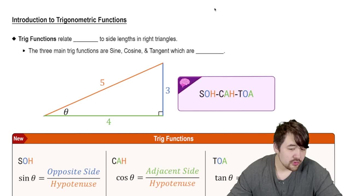
Trigonometric functions relate the angles of a triangle to the lengths of its sides. The primary functions include sine (sin), cosine (cos), and tangent (tan), along with their reciprocals: cosecant (csc), secant (sec), and cotangent (cot). Understanding these functions is essential for solving problems involving angles and triangles, particularly in different quadrants.
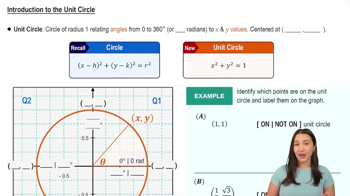
The unit circle is divided into four quadrants, each corresponding to specific signs of the trigonometric functions. In Quadrant III, both sine and cosine values are negative, while tangent values are positive. Recognizing the quadrant in which an angle lies helps determine the signs of the trigonometric functions, which is crucial for finding exact values.
The Pythagorean identity states that for any angle θ, the relationship sin²(θ) + cos²(θ) = 1 holds true. This identity allows us to find the values of sine and other trigonometric functions when given the value of cosine or sine. In this case, knowing cos(θ) enables us to calculate sin(θ) and subsequently the other trigonometric functions.