A crate is supported by two ropes. One rope makes an angle of 46° 20′ with the horizontal and has a tension of 89.6 lb on it. The other rope is horizontal. Find the weight of the crate and the tension in the horizontal rope.
Verified step by step guidance
1
Identify the forces acting on the crate: the weight (W) acting vertically downward, the tension in the inclined rope (T_1 = 89.6 lb) at an angle of 46° 20′ with the horizontal, and the tension in the horizontal rope (T_2) acting horizontally.
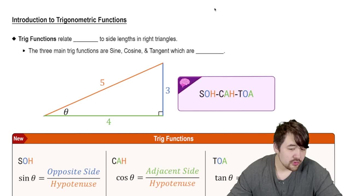
Resolve the tension in the inclined rope into its horizontal and vertical components using trigonometric functions: the horizontal component is \(T_1 \cos(46^\circ 20')\) and the vertical component is \(T_1 \sin(46^\circ 20')\).
Since the crate is in equilibrium, apply the condition that the sum of forces in the horizontal direction is zero: \(T_2 = T_1 \cos(46^\circ 20')\).
Apply the equilibrium condition in the vertical direction: the upward vertical component of the inclined rope's tension balances the weight of the crate, so \(W = T_1 \sin(46^\circ 20')\).
Use the above equations to express the weight of the crate and the tension in the horizontal rope in terms of the given tension and angle, then calculate their numerical values if needed.
Verified video answer for a similar problem:
This video solution was recommended by our tutors as helpful for the problem above
Play a video:
0 Comments
Key Concepts
Here are the essential concepts you must grasp in order to answer the question correctly.
Resolving Forces into Components
Forces acting at an angle can be broken down into horizontal and vertical components using trigonometric functions sine and cosine. This allows analysis of each direction separately, which is essential for solving equilibrium problems involving multiple forces.
An object in equilibrium has no net force acting on it, meaning the sum of forces in both horizontal and vertical directions must be zero. This principle helps set up equations to find unknown tensions and weights in static systems.
Understanding how to use sine and cosine with angles given in degrees and minutes is crucial. Converting 46° 20′ into decimal degrees allows accurate calculation of force components, ensuring precise results in tension and weight determination.

 Verified step by step guidance
 03:55
03:55