A force of 18.0 lb is required to hold a 60.0-lb stump grinder on an incline. What angle does the incline make with the horizontal?
Table of contents
- 0. Review of College Algebra4h 45m
- 1. Measuring Angles40m
- 2. Trigonometric Functions on Right Triangles2h 5m
- 3. Unit Circle1h 19m
- 4. Graphing Trigonometric Functions1h 19m
- 5. Inverse Trigonometric Functions and Basic Trigonometric Equations1h 41m
- 6. Trigonometric Identities and More Equations2h 34m
- 7. Non-Right Triangles1h 38m
- 8. Vectors2h 25m
- 9. Polar Equations2h 5m
- 10. Parametric Equations1h 6m
- 11. Graphing Complex Numbers1h 7m
8. Vectors
Geometric Vectors
Problem 45
Textbook Question
A ship leaves port on a bearing of 34.0° and travels 10.4 mi. The ship then turns due east and travels 4.6 mi. How far is the ship from port, and what is its bearing from port?
Verified step by step guidance1
Draw a diagram to visualize the ship's path: start at the port (origin), draw a line representing the ship's first leg of 10.4 miles at a bearing of 34.0° from north, then from that point draw a second leg 4.6 miles due east.
Resolve the first leg of the journey into its north-south and east-west components using trigonometry: calculate the eastward component as \(10.4 \times \sin(34.0^\circ)\) and the northward component as \(10.4 \times \cos(34.0^\circ)\).
Add the eastward component of the second leg (4.6 miles due east) to the eastward component from the first leg to get the total eastward displacement from the port. The northward displacement remains the same as from the first leg since the second leg is due east.
Use the Pythagorean theorem to find the straight-line distance from the port to the ship's final position: calculate \(\sqrt{(\text{total eastward displacement})^2 + (\text{northward displacement})^2}\).
Find the bearing from the port to the ship's final position by calculating the angle east of north using the inverse tangent function: \(\theta = \tan^{-1}\left(\frac{\text{total eastward displacement}}{\text{northward displacement}}\right)\). This angle is the bearing measured clockwise from north.
Verified video answer for a similar problem:This video solution was recommended by our tutors as helpful for the problem above
Video duration:
10mPlay a video:
0 Comments
Key Concepts
Here are the essential concepts you must grasp in order to answer the question correctly.
Bearing and Direction in Navigation
Bearing is the direction or path along which something moves, measured in degrees clockwise from the north. Understanding how to interpret bearings, such as 34°, is essential for determining the ship's initial direction relative to the port.
Recommended video:
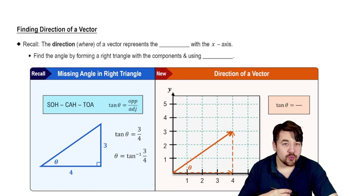
Finding Direction of a Vector
Vector Addition and Displacement
The ship's journey involves two legs with different directions, so its overall displacement is found by vector addition. Breaking each leg into components (using trigonometric functions) allows calculation of the resultant position relative to the starting point.
Recommended video:
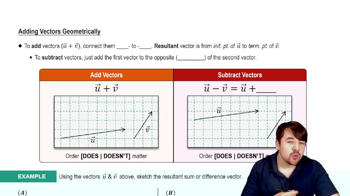
Adding Vectors Geometrically
Trigonometric Functions and Distance Calculation
Using sine and cosine functions helps resolve distances into perpendicular components. The Pythagorean theorem then calculates the straight-line distance from the port, and inverse trigonometric functions determine the bearing from the port.
Recommended video:
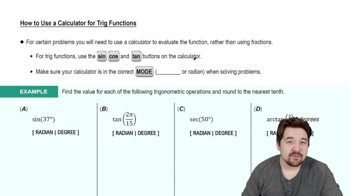
How to Use a Calculator for Trig Functions
Related Videos
Related Practice
Textbook Question
740
views