A luxury liner leaves port on a bearing of 110.0° and travels 8.8 mi. It then turns due west and travels 2.4 mi. How far is the liner from port, and what is its bearing from port?
Verified step by step guidance
1
Draw a diagram to visualize the problem: start at the port (point O), draw a line representing the first leg of the journey at a bearing of 110.0° from north, and mark the endpoint after traveling 8.8 miles (point A). Then, from point A, draw a line due west (270°) for 2.4 miles to point B, the liner's final position.
Resolve the first leg of the journey into its north-south and east-west components using trigonometry. Since the bearing is measured clockwise from north, calculate the east (x) and north (y) components as follows:
\(x_{A} = 8.8 \times \sin(110.0^\circ)\)
\(y_{A} = 8.8 \times \cos(110.0^\circ)\)
Calculate the coordinates of the final position (point B) relative to the port by adjusting the east-west component for the second leg:
\(x_{B} = x_{A} - 2.4\) (since the liner travels west, subtract 2.4 miles from the east component)
\(y_{B} = y_{A}\) (north-south component remains the same as the second leg is due west).
Find the straight-line distance from the port to the liner's final position using the Pythagorean theorem:
\(distance = \sqrt{(x_{B})^{2} + (y_{B})^{2}}\)
Determine the bearing from the port to the liner's final position by calculating the angle relative to north:
\(\theta = \arctan\left(\frac{|x_{B}|}{|y_{B}|}\right)\)
Adjust the angle based on the quadrant where point B lies to express the bearing as degrees clockwise from north.
Verified video answer for a similar problem:
This video solution was recommended by our tutors as helpful for the problem above
Play a video:
0 Comments
Key Concepts
Here are the essential concepts you must grasp in order to answer the question correctly.
Bearing and Direction in Navigation
Bearing is the direction or path along which something moves, measured in degrees clockwise from the north. Understanding bearings helps translate directional instructions into angles on a coordinate plane, essential for plotting the liner's path and determining its final position relative to the starting point.
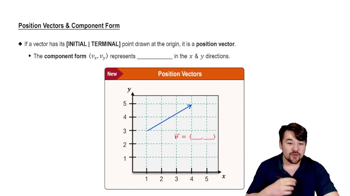
Vector addition involves combining displacement vectors by breaking them into components along perpendicular axes, typically east-west and north-south. This allows calculation of the resultant displacement by summing components, which is crucial for finding the liner's overall distance and direction from the port.
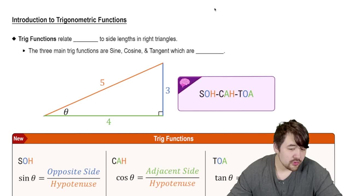
Trigonometric functions like sine and cosine relate angles to side lengths in right triangles, enabling calculation of vector components. The Pythagorean theorem then finds the resultant distance, and inverse trigonometric functions determine the bearing angle from the components, completing the solution.

 Verified step by step guidance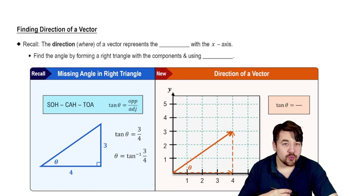
 05:13
05:13