A force of 30.0 lb is required to hold an 80.0-lb pressure washer on an incline. What angle does the incline make with the horizontal?
Table of contents
- 0. Review of College Algebra4h 45m
- 1. Measuring Angles40m
- 2. Trigonometric Functions on Right Triangles2h 5m
- 3. Unit Circle1h 19m
- 4. Graphing Trigonometric Functions1h 19m
- 5. Inverse Trigonometric Functions and Basic Trigonometric Equations1h 41m
- 6. Trigonometric Identities and More Equations2h 34m
- 7. Non-Right Triangles1h 38m
- 8. Vectors2h 25m
- 9. Polar Equations2h 5m
- 10. Parametric Equations1h 6m
- 11. Graphing Complex Numbers1h 7m
8. Vectors
Geometric Vectors
Problem 47
Textbook Question
Starting at point A, a ship sails 18.5 km on a bearing of 189°, then turns and sails 47.8 km on a bearing of 317°. Find the distance of the ship from point A.
Verified step by step guidance1
Understand the problem: The ship starts at point A, sails 18.5 km on a bearing of 189°, then changes direction and sails 47.8 km on a bearing of 317°. We need to find the straight-line distance from the final position back to point A.
Convert the bearings into standard angles relative to the positive x-axis (east direction). Bearings are measured clockwise from north, so to convert a bearing \( \theta_b \) to an angle \( \theta \) from the positive x-axis, use \( \theta = 90° - \theta_b \). Adjust the angle to be between 0° and 360° if necessary.
Calculate the coordinates of the ship after each leg of the journey using trigonometry: For each leg, the change in x (east-west) is \( \Delta x = d \times \cos(\theta) \) and the change in y (north-south) is \( \Delta y = d \times \sin(\theta) \), where \( d \) is the distance sailed and \( \theta \) is the angle from the positive x-axis.
Sum the x and y components from both legs to find the final coordinates \( (x, y) \) of the ship relative to point A.
Use the distance formula to find the straight-line distance from point A to the final position: \[ \text{Distance} = \sqrt{x^2 + y^2} \].
Verified video answer for a similar problem:This video solution was recommended by our tutors as helpful for the problem above
Play a video:
0 Comments
Key Concepts
Here are the essential concepts you must grasp in order to answer the question correctly.
Bearings and Direction
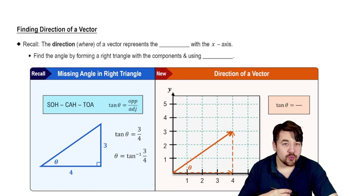
Bearings are angles measured clockwise from the north direction to indicate direction. Understanding how to interpret bearings like 189° and 317° is essential for plotting the ship's path relative to the starting point.
Recommended video:
Finding Direction of a Vector
Vector Representation of Displacement
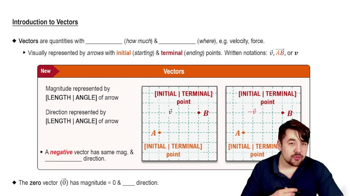
Each leg of the ship's journey can be represented as a vector with magnitude (distance sailed) and direction (bearing). Converting these vectors into components allows for the calculation of the resultant displacement from the starting point.
Recommended video:
Introduction to Vectors
Distance Calculation Using the Pythagorean Theorem or Law of Cosines
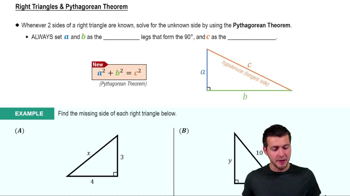
After determining the resultant vector components or the angle between legs, the distance from the starting point can be found using the Pythagorean theorem for perpendicular components or the Law of Cosines for non-right triangles.
Recommended video:
Solving Right Triangles with the Pythagorean Theorem
Related Videos
Related Practice
Textbook Question
796
views