
Pearson+ LogoPearson+ Logo
Ch. 33 Control Systems in Plants
Taylor - Campbell Biology: Concepts & Connections 10th Edition
Taylor, Simon, Dickey, Hogan10th EditionCampbell Biology: Concepts & ConnectionsISBN: 9780136538783Not the one you use?Change textbook
Chapter 33, Problem 17

Write a short paragraph explaining why a houseplant becomes bushier if you pinch off its terminal buds.

Verified step by step guidance
1
Understand the role of terminal buds: Terminal buds are located at the tips of stems and branches and are responsible for the vertical growth of the plant. They produce hormones called auxins that inhibit the growth of lateral buds (side shoots).
Recognize the effect of pinching off terminal buds: When you pinch off the terminal buds, you remove the source of auxins. This reduction in auxin levels allows the lateral buds, which were previously dormant, to start growing.
Identify the growth of lateral buds: With the inhibition lifted, the lateral buds begin to grow and develop into new branches. This results in the plant becoming bushier as more branches mean more leaves and potentially more flowers.
Consider the overall plant health and appearance: A bushier plant not only has more aesthetic appeal but can also lead to a healthier plant. More branches and leaves increase the plant's ability to photosynthesize, enhancing its growth and vitality.
Apply regular maintenance: To maintain a bushy appearance and encourage healthy growth, continue to pinch off new terminal buds as they form. This will keep promoting the growth of lateral buds and help the plant maintain its bushy shape.

Verified video answer for a similar problem:

This video solution was recommended by our tutors as helpful for the problem above.
Video duration:
1m
Was this helpful?

Key Concepts

Here are the essential concepts you must grasp in order to answer the question correctly.

Apical Dominance

Apical dominance is a phenomenon in plants where the main central stem grows more strongly than the other side stems. This is primarily due to the production of auxins, which are hormones that promote growth at the tips of the plant. When the terminal bud is intact, it suppresses the growth of lateral buds, leading to a taller but less bushy plant.
Recommended video:
Guided course
03:09
Incomplete Dominance

Lateral Bud Activation

When the terminal bud is pinched off, the suppression of lateral buds is removed, allowing them to grow. This process is known as lateral bud activation. As these buds begin to develop, they contribute to a fuller, bushier appearance of the plant, as more branches and leaves emerge from the sides.
Recommended video:
Guided course
02:37
Active Transport

Hormonal Regulation in Plants

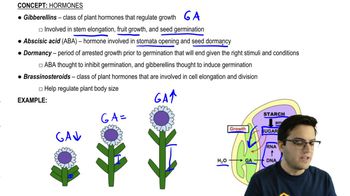
Plants regulate their growth and development through hormones, with auxins, cytokinins, and gibberellins playing key roles. Auxins promote elongation and apical dominance, while cytokinins encourage cell division and lateral growth. By manipulating these hormonal balances through practices like pinching, gardeners can influence the shape and density of houseplants.
Recommended video:
Guided course
08:18
Plant Hormones and Senescence
Related Practice
Textbook Question

"Match each definition with the correct term.

Bending of a shoot toward light, Growth response to touch, Cycle with a period of about 24 hours Pigment that helps control flowering Relative lengths of night and day Growth response to gravity Folding of plant leaves at night

a. Phytochrome

b. Photoperiod

c. Sleep movement

d. Circadian rhythm

e. Thigmotropism

f. Phototropism

g. Gravitropism"

951
views
Textbook Question
A certain short-day plant flowers only when days are less than 12 hours long. Which of the following would cause it to flower?a. a 9-hour night and 15-hour day with 1 minute of darkness after 7 hoursb. an 8-hour day and 16-hour night with a flash of white light after 8 hoursc. a 13-hour night and 11-hour day with 1 minute of darkness after 6 hoursd. a 12-hour day and 12-hour night with a flash of red light after 6 hours
1306
views
Textbook Question

If apples are to be stored for long periods, it is best to keep them in a place with good air circulation. Explain why.

993
views
Textbook Question
A plant nursery manager tells the new night security guard to stay out of a room where chrysanthemums (which are short-day plants) are about to flower. Around midnight, the guard accidentally opens the door to the chrysanthemum room and turns on the lights for a moment. How might this affect the chrysanthemums? How could the guard correct the mistake?
756
views
Textbook Question

A plant biologist observed a peculiar pattern when a tropical shrub was attacked by caterpillars. After a caterpillar ate a leaf, it would skip over nearby leaves and attack a leaf some distance away. Simply removing a leaf did not trigger the same change nearby. The biologist suspected that a damaged leaf sent out a chemical that signaled other leaves. How could this hypothesis be tested?

1049
views
Textbook Question
Imagine the following scenario: A plant biologist has developed a synthetic chemical that mimics the effects of a plant hormone. The chemical can be sprayed on apples before harvest to prevent flaking of the natural wax that is formed on the skin. This makes the apples shinier and gives them a deeper red color. What kinds of questions do you think should be answered before farmers start using this chemical on apples? How might the scientist go about finding answers to these questions?
843
views