42–76. Convergence or divergence Use a convergence test of your choice to determine whether the following series converge. ∑ (from k = 1 to ∞)tanh(k)
Verified step by step guidance
1
Identify the series given: \( \sum_{k=1}^{\infty} \tanh(k) \). We want to determine if this infinite series converges or diverges.
Recall that for a series \( \sum a_k \) to converge, the terms \( a_k \) must approach zero as \( k \to \infty \). So, first examine the behavior of \( \tanh(k) \) as \( k \to \infty \).
Note that \( \tanh(k) = \frac{e^{k} - e^{-k}}{e^{k} + e^{-k}} \). As \( k \to \infty \), \( e^{k} \) dominates \( e^{-k} \), so \( \tanh(k) \to 1 \).
Since the terms \( \tanh(k) \) do not approach zero but instead approach 1, the necessary condition for series convergence is not met.
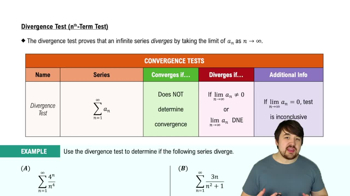
Therefore, by the Test for Divergence (also called the nth-term test), the series \( \sum_{k=1}^{\infty} \tanh(k) \) diverges.
Verified video answer for a similar problem:
This video solution was recommended by our tutors as helpful for the problem above
Video duration:
2m
Play a video:
0 Comments
Key Concepts
Here are the essential concepts you must grasp in order to answer the question correctly.
Infinite Series and Convergence
An infinite series is the sum of infinitely many terms. Determining whether such a series converges means checking if the sum approaches a finite limit as the number of terms grows indefinitely. Understanding convergence is essential to analyze the behavior of series like ∑ tanh(k).
Behavior of the Hyperbolic Tangent Function (tanh)
The hyperbolic tangent function, tanh(k), approaches 1 as k becomes very large. Since its terms do not approach zero, this behavior is critical in assessing the convergence of the series ∑ tanh(k), because terms must approach zero for the series to have a chance to converge.
The divergence test states that if the limit of the terms of a series does not approach zero, the series diverges. This is a quick and effective test to determine divergence, especially useful here since lim(k→∞) tanh(k) = 1 ≠ 0, implying the series diverges.