42–76. Convergence or divergence Use a convergence test of your choice to determine whether the following series converge. ∑ (from k = 1 to ∞)2ᵏ / eᵏ
Verified step by step guidance
1
Identify the given series: \( \sum_{k=1}^{\infty} \frac{2^k}{e^k} \). This is a series where each term is \( \frac{2^k}{e^k} \).
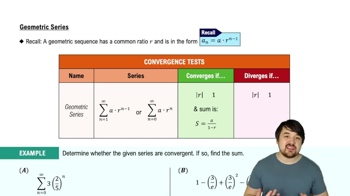
Rewrite the general term to recognize the type of series: \( \frac{2^k}{e^k} = \left( \frac{2}{e} \right)^k \). This shows the series is geometric with common ratio \( r = \frac{2}{e} \).
Recall the convergence criterion for a geometric series: A geometric series \( \sum r^k \) converges if and only if \( |r| < 1 \).
Evaluate the absolute value of the common ratio: \( \left| \frac{2}{e} \right| \). Since \( e \approx 2.718 \), compare \( 2 \) and \( e \) to determine if \( |r| < 1 \).
Based on the comparison, conclude whether the series converges or diverges by applying the geometric series test.
Verified video answer for a similar problem:
This video solution was recommended by our tutors as helpful for the problem above
Video duration:
2m
Play a video:
0 Comments
Key Concepts
Here are the essential concepts you must grasp in order to answer the question correctly.
Infinite Series
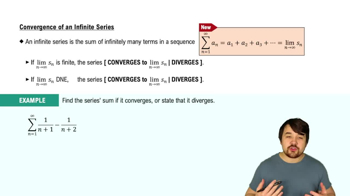
An infinite series is the sum of infinitely many terms, often expressed as ∑ a_k from k=1 to ∞. Understanding whether such a series converges (approaches a finite limit) or diverges (grows without bound or oscillates) is fundamental in calculus.
A geometric series has terms of the form ar^k. The Ratio Test compares the limit of |a_(k+1)/a_k| to 1; if less than 1, the series converges absolutely. This test is especially useful for series with exponential terms like 2^k/e^k.
Exponential functions like 2^k and e^k grow at different rates. Since e ≈ 2.718, e^k grows faster than 2^k, which affects the behavior of the terms and helps determine convergence by comparing numerator and denominator growth.