Explain why or why not Determine whether the following statements are true and give an explanation or counterexample.
g.The series ∑ (from k = 1 to ∞) (k² / (k² + 1)) converges.
Verified step by step guidance
1
Identify the general term of the series: \( a_k = \frac{k^2}{k^2 + 1} \).
Examine the behavior of \( a_k \) as \( k \to \infty \). Calculate the limit \( \lim_{k \to \infty} a_k = \lim_{k \to \infty} \frac{k^2}{k^2 + 1} \).
Since the degrees of numerator and denominator are the same, the limit is the ratio of the leading coefficients, which is \( 1 \). So, \( \lim_{k \to \infty} a_k = 1 \).
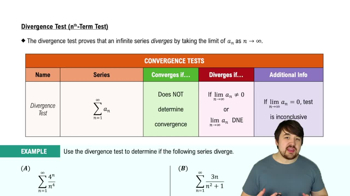
Recall the Divergence Test (also called the Test for Divergence): if \( \lim_{k \to \infty} a_k \neq 0 \), then the series \( \sum a_k \) diverges.
Because \( \lim_{k \to \infty} a_k = 1 \neq 0 \), the series \( \sum_{k=1}^\infty \frac{k^2}{k^2 + 1} \) does not converge; it diverges.
Verified video answer for a similar problem:
This video solution was recommended by our tutors as helpful for the problem above
Video duration:
2m
Play a video:
0 Comments
Key Concepts
Here are the essential concepts you must grasp in order to answer the question correctly.
Definition of Series Convergence
A series converges if the sequence of its partial sums approaches a finite limit as the number of terms goes to infinity. If the partial sums do not approach a finite value, the series diverges. Understanding this helps determine whether the given infinite sum converges or not.
If the terms of a series do not approach zero as k approaches infinity, the series must diverge. This is a quick test to check convergence; if the limit of the general term is not zero, the series cannot converge.
Analyzing the limit of the term k² / (k² + 1) as k approaches infinity shows it approaches 1, not zero. Since the terms do not tend to zero, this indicates the series ∑ (k² / (k² + 1)) diverges by the term test.