Finding steady states using infinite series Solve Exercise 40 by expressing the amount of aspirin in your blood as a geometric series and evaluating the series.
Ch. 10 - Sequences and Infinite Series
Briggs3rd EditionCalculus: Early TranscendentalsISBN: 9780136847243Not the one you use?Change textbook
Chapter 10, Problem 10.R.91
Estimate the value of the series ∑ (from k = 1 to ∞)1 / (2k + 5)³ to within 10⁻⁴ of its exact value.
Verified step by step guidance1
Recognize that the series \( \sum_{k=1}^{\infty} \frac{1}{(2k+5)^3} \) is a positive, decreasing series with terms of the form \( a_k = \frac{1}{(2k+5)^3} \). Since the terms decrease and are positive, we can use the Integral Test remainder estimate to approximate the error when truncating the series.
To estimate the sum within an error of \( 10^{-4} \), first decide how many terms \( N \) to sum. The remainder \( R_N = \sum_{k=N+1}^{\infty} \frac{1}{(2k+5)^3} \) can be bounded by an integral: \[ R_N \leq \int_{N}^{\infty} \frac{1}{(2x+5)^3} \, dx. \]
Evaluate the integral \( \int_{N}^{\infty} \frac{1}{(2x+5)^3} \, dx \) by substitution. Let \( u = 2x + 5 \), so \( du = 2 \, dx \) or \( dx = \frac{du}{2} \). Change the limits accordingly and integrate \( \int \frac{1}{u^3} \cdot \frac{du}{2} \).
After integrating, express the remainder bound \( R_N \) in terms of \( N \). Set this bound less than or equal to \( 10^{-4} \) and solve for \( N \) to find the minimum number of terms needed to guarantee the desired accuracy.
Finally, sum the first \( N \) terms of the series \( \sum_{k=1}^{N} \frac{1}{(2k+5)^3} \) to get an approximation of the infinite series within \( 10^{-4} \) of the exact value.

Verified video answer for a similar problem:
This video solution was recommended by our tutors as helpful for the problem above.
Video duration:
6mWas this helpful?
Key Concepts
Here are the essential concepts you must grasp in order to answer the question correctly.
Infinite Series and Convergence
An infinite series is the sum of infinitely many terms. To work with such series, it is crucial to determine if they converge to a finite value. For series with positive terms decreasing to zero, convergence can often be tested using comparison or integral tests.
Recommended video:
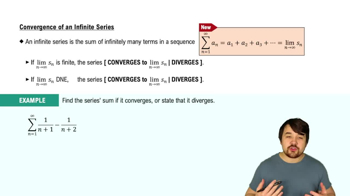
Convergence of an Infinite Series
Remainder Estimation for Series
When approximating an infinite series by partial sums, the remainder (or error) is the difference between the exact sum and the partial sum. Estimating this remainder helps ensure the approximation is within a desired accuracy, often using integral bounds or known inequalities.
Recommended video:
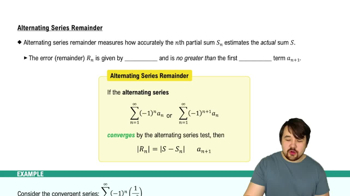
Alternating Series Remainder
Integral Test and Integral Bounds
The integral test relates a series to an improper integral to determine convergence and estimate remainders. For a decreasing positive function, the remainder after n terms can be bounded by integrals of the function from n to infinity, providing a practical way to estimate errors.
Recommended video:
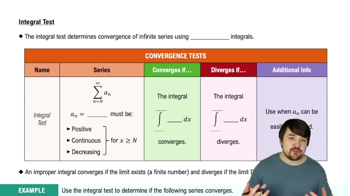
Integral Test
Related Practice
Textbook Question
53
views
Textbook Question
42–76. Convergence or divergence Use a convergence test of your choice to determine whether the following series converge.
∑ (from k = 1 to ∞)5ᵏ / 2²ᵏ⁺¹
42
views
Textbook Question
Geometric sums
Evaluate the geometric sums
∑ (from k = 0 to 9) (0.2)ᵏand∑ (from k = 2 to 9) (0.2)ᵏ.
50
views
Textbook Question
Explain why or why not
Determine whether the following statements are true and give an explanation or counterexample.
a.The terms of the sequence {aₙ} increase in magnitude, so the limit of the sequence does not exist.
43
views
Textbook Question
12–24. Limits of sequences Evaluate the limit of the sequence or state that it does not exist.
aₙ = (2ⁿ + 5ⁿ⁺¹) / 5ⁿ
39
views
Textbook Question
b.Does the series ∑ (from k = 1 to ∞) k/(k + 1) converge? Why or why not?
86
views