
Ch. 10 - Sequences and Infinite Series
Briggs - Calculus: Early Transcendentals 3rd Edition
Briggs3rd EditionCalculus: Early TranscendentalsISBN: 9780136847243Not the one you use?Change textbook
Chapter 10, Problem 10.4.47a

Explain why or why not Determine whether the following statements are true and give an explanation or counterexample.


a. The sum ∑ (k = 1 to ∞) 1 / 3ᵏ is a p-series.

Verified step by step guidance
1
Recall the definition of a p-series: a series of the form \(\sum_{k=1}^{\infty} \frac{1}{k^p}\), where \(p\) is a positive real number.
Examine the given series: \(\sum_{k=1}^{\infty} \frac{1}{3^k}\). Notice that the denominator is \$3^k\(, which is an exponential expression, not a power of \)k$.
Since the denominator is not of the form \(k^p\), the series does not fit the definition of a p-series.
Instead, the given series is a geometric series with common ratio \(r = \frac{1}{3}\), because each term is obtained by multiplying the previous term by \(\frac{1}{3}\).
Therefore, the statement that the series is a p-series is false; it is actually a geometric series.

Verified video answer for a similar problem:

This video solution was recommended by our tutors as helpful for the problem above.
Video duration:
1m
Was this helpful?

Key Concepts

Here are the essential concepts you must grasp in order to answer the question correctly.

Definition of a p-series

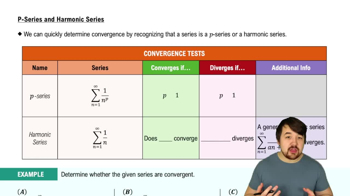
A p-series is an infinite series of the form ∑ 1/n^p, where n starts at 1 and p is a positive constant. It converges if and only if p > 1. Recognizing whether a series fits this form is essential to classify it as a p-series.
Recommended video:
04:30
P-Series and Harmonic Series

Geometric series

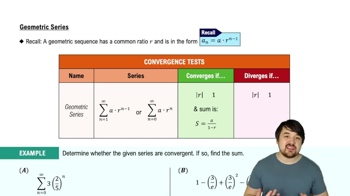
A geometric series is an infinite sum where each term is a constant ratio r times the previous term, expressed as ∑ ar^k. It converges if |r| < 1, and its sum can be calculated using the formula a/(1-r). Identifying geometric series helps distinguish them from p-series.
Recommended video:
06:00
Geometric Series

Series classification and counterexamples

Determining whether a series belongs to a specific type requires comparing its general term to the defining form. Providing counterexamples or explanations clarifies why a series does or does not fit a category, aiding in understanding convergence properties.
Recommended video:
06:00
Geometric Series
Related Practice
Textbook Question

88–89. Binary numbers

Humans use the ten digits 0 through 9 to form base-10 or decimal numbers, whereas computers calculate and store numbers internally as binary numbers—numbers consisting entirely of 0’s and 1’s. For this exercise, we consider binary numbers that have the form 0.b₁b₂b₃⋯, where each of the digits b₁, b₂, b₃, ⋯ is either 0 or 1. The base-10 representation of the binary number 0.b₁b₂b₃⋯ is the infinite series

b₁ / 2¹ + b₂ / 2² + b₃ / 2³ + ⋯


89. Computers can store only a finite number of digits and therefore numbers with nonterminating digits must be rounded or truncated before they can be used and stored by a computer.


a. Find the base-10 representation of the binary number 0.001̅1.

70
views
Textbook Question

Explain why or why not

Determine whether the following statements are true and give an explanation or counterexample.

a.If limₙ→∞aₙ = 1 and limₙ→∞bₙ = 3, then limₙ→∞(bₙ / aₙ) = 3.

48
views
Textbook Question

27–34. Working with sequences Several terms of a sequence {aₙ}ₙ₌₁∞ are given.

a. Find the next two terms of the sequence.

{-5, 5, -5, 5, ......}

47
views
Textbook Question

87. Explain why or why not

Determine whether the following statements are true and give an explanation or counterexample.


a. If ∑ (k = 1 to ∞) aₖ converges, then ∑ (k = 10 to ∞) aₖ converges.

47
views
Textbook Question

Loglog p-series Consider the series ∑ (k = 2 to ∞) 1 / (k(ln k)(ln ln k)ᵖ), where p is a real number.

a. For what values of p does this series converge?

52
views
Textbook Question

{Use of Tech} Repeated square roots

Consider the sequence defined by

aₙ₊₁ = √(2 + aₙ),a₀ = √2, for n = 0, 1, 2, 3, …


a.Evaluate the first four terms of the sequence {aₙ}.

State the exact values first, and then the approximate values.

38
views