
Ch. 10 - Sequences and Infinite Series
Briggs - Calculus: Early Transcendentals 3rd Edition
Briggs3rd EditionCalculus: Early TranscendentalsISBN: 9780136847243Not the one you use?Change textbook
Chapter 10, Problem 10.4.65a

Loglog p-series Consider the series ∑ (k = 2 to ∞) 1 / (k(ln k)(ln ln k)ᵖ), where p is a real number.
a. For what values of p does this series converge?

Verified step by step guidance
1
Recognize that the given series is \( \sum_{k=2}^{\infty} \frac{1}{k (\ln k) (\ln \ln k)^p} \), which is a type of log-log p-series. To analyze its convergence, consider using the Integral Test because the terms are positive, continuous, and decreasing for sufficiently large \( k \).
Set up the corresponding integral to apply the Integral Test: \[ \int_2^{\infty} \frac{1}{x (\ln x) (\ln \ln x)^p} \, dx. \] The convergence of this integral will determine the convergence of the series.
Make the substitution \( t = \ln \ln x \). Then, compute \( dt \) in terms of \( dx \): since \( t = \ln(\ln x) \), we have \( dt = \frac{1}{\ln x} \cdot \frac{1}{x} dx \), which implies \( dx = x (\ln x) dt \). This substitution simplifies the integral to \[ \int_{t_0}^{\infty} \frac{1}{t^p} dt, \] where \( t_0 = \ln \ln 2 \).
Analyze the integral \( \int_{t_0}^{\infty} \frac{1}{t^p} dt \). This is a p-type integral, which converges if and only if \( p > 1 \) and diverges otherwise.
Conclude that the original series \( \sum_{k=2}^{\infty} \frac{1}{k (\ln k) (\ln \ln k)^p} \) converges if and only if \( p > 1 \), and diverges for \( p \leq 1 \).

Verified video answer for a similar problem:

This video solution was recommended by our tutors as helpful for the problem above.
Video duration:
2m
Was this helpful?

Key Concepts

Here are the essential concepts you must grasp in order to answer the question correctly.

p-Series and Generalized p-Series

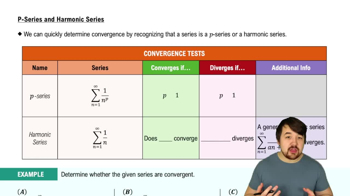
A p-series is a series of the form ∑ 1/n^p, which converges if and only if p > 1. The given series extends this idea by including logarithmic factors in the denominator, requiring an understanding of how these additional terms affect convergence compared to the standard p-series.
Recommended video:
04:30
P-Series and Harmonic Series

Integral Test for Convergence

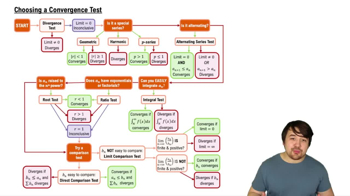
The integral test relates the convergence of a series to the convergence of an improper integral of a corresponding function. For positive, decreasing functions, the series ∑ a_k converges if and only if the integral of f(x) from some point to infinity converges. This test is useful for series involving logarithmic terms.
Recommended video:
07:51
Choosing a Convergence Test

Behavior of Logarithmic Functions in Series

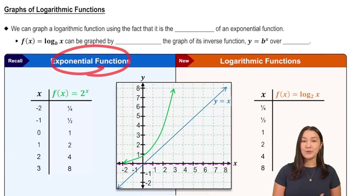
Logarithmic functions like ln(k) and ln(ln(k)) grow slowly, affecting the convergence of series subtly. Understanding how powers of these nested logarithms influence the terms' decay rate is crucial to determining for which values of p the series converges.
Recommended video:
5:26
Graphs of Logarithmic Functions
Related Practice
Textbook Question

{Use of Tech} A savings plan

James begins a savings plan in which he deposits \(100 at the beginning of each month into an account that earns 9% interest annually, or equivalently, 0.75% per month.

To be clear, on the first day of each month, the bank adds 0.75% of the current balance as interest, and then James deposits \)100.


Let Bₙ be the balance in the account after the nᵗʰ payment, where B₀ = \$0.


a.Write the first five terms of the sequence {Bₙ}.

57
views
Textbook Question

88–89. Binary numbers

Humans use the ten digits 0 through 9 to form base-10 or decimal numbers, whereas computers calculate and store numbers internally as binary numbers—numbers consisting entirely of 0’s and 1’s. For this exercise, we consider binary numbers that have the form 0.b₁b₂b₃⋯, where each of the digits b₁, b₂, b₃, ⋯ is either 0 or 1. The base-10 representation of the binary number 0.b₁b₂b₃⋯ is the infinite series

b₁ / 2¹ + b₂ / 2² + b₃ / 2³ + ⋯


89. Computers can store only a finite number of digits and therefore numbers with nonterminating digits must be rounded or truncated before they can be used and stored by a computer.


a. Find the base-10 representation of the binary number 0.001̅1.

70
views
Textbook Question

Explain why or why not

Determine whether the following statements are true and give an explanation or counterexample.

a.If limₙ→∞aₙ = 1 and limₙ→∞bₙ = 3, then limₙ→∞(bₙ / aₙ) = 3.

48
views
Textbook Question

27–34. Working with sequences Several terms of a sequence {aₙ}ₙ₌₁∞ are given.

a. Find the next two terms of the sequence.

{-5, 5, -5, 5, ......}

47
views
Textbook Question

Explain why or why not Determine whether the following statements are true and give an explanation or counterexample.


a. The sum ∑ (k = 1 to ∞) 1 / 3ᵏ is a p-series.

56
views
Textbook Question

41–44. {Use of Tech} Remainders and estimates Consider the following convergent series.


a. Find an upper bound for the remainder in terms of n.


41. ∑ (k = 1 to ∞) 1 / k⁶

105
views