

Ch. 10 - Sequences and Infinite Series
Briggs - Calculus: Early Transcendentals 3rd Edition
Briggs3rd EditionCalculus: Early TranscendentalsISBN: 9780136847243Not the one you use?Change textbook
Chapter 10, Problem 10.2.83b

Explain why or why not
Determine whether the following statements are true and give an explanation or counterexample.


b.If limₙ→∞aₙ = 0 and limₙ→∞bₙ = ∞, then limₙ→∞aₙbₙ = 0.

Verified step by step guidance
1
Step 1: Understand the given limits. We have two sequences \(a_n\) and \(b_n\) such that \(\lim_{n \to \infty} a_n = 0\) and \(\lim_{n \to \infty} b_n = \infty\). This means \(a_n\) approaches zero and \(b_n\) grows without bound as \(n\) becomes very large.
Step 2: Analyze the product \(a_n b_n\). The question asks if \(\lim_{n \to \infty} a_n b_n = 0\) necessarily holds. Since \(a_n\) tends to zero and \(b_n\) tends to infinity, the product is an indeterminate form of type \(0 \times \infty\). This means the limit could be zero, infinite, or some finite number depending on the rates at which \(a_n\) approaches zero and \(b_n\) grows.
Step 3: Consider a counterexample to test the statement. For instance, if \(a_n = \frac{1}{n}\) and \(b_n = n\), then \(a_n b_n = \frac{1}{n} \times n = 1\), which does not tend to zero but to 1. This shows the statement is not always true.
Step 4: Alternatively, if \(a_n = \frac{1}{n^2}\) and \(b_n = n\), then \(a_n b_n = \frac{1}{n^2} \times n = \frac{1}{n}\), which tends to zero. This shows the limit can be zero in some cases.
Step 5: Conclusion: Since the product limit depends on the relative rates of \(a_n\) and \(b_n\), the statement "If \(\lim_{n \to \infty} a_n = 0\) and \(\lim_{n \to \infty} b_n = \infty\), then \(\lim_{n \to \infty} a_n b_n = 0\)" is not necessarily true. It requires additional conditions to hold.

Verified video answer for a similar problem:

This video solution was recommended by our tutors as helpful for the problem above.
Video duration:
3m
Was this helpful?

Key Concepts

Here are the essential concepts you must grasp in order to answer the question correctly.

Limits of Sequences

The limit of a sequence describes the value that the terms of the sequence approach as the index goes to infinity. Understanding how to evaluate limits of sequences is fundamental to analyzing their long-term behavior and determining convergence or divergence.
Recommended video:
Guided course
8:22
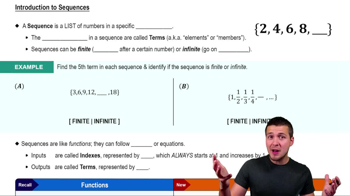
Introduction to Sequences

Indeterminate Forms

An indeterminate form arises when the limit of a product or quotient involves conflicting behaviors, such as one factor approaching zero and another approaching infinity. In such cases, the limit cannot be directly concluded and requires further analysis or counterexamples.
Recommended video:
6:20
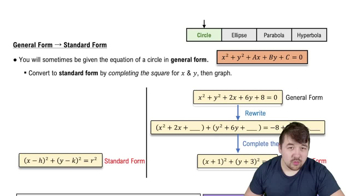
Circles in General Form

Counterexamples in Limit Analysis

Counterexamples are specific cases that disprove a general statement. When evaluating limit statements, constructing or identifying sequences that violate the proposed limit helps demonstrate whether the statement is true or false.
Recommended video:
05:50
One-Sided Limits
Related Practice
Textbook Question

72–75. {Use of Tech} Practical sequences

Consider the following situations that generate a sequence


c.Find a recurrence relation that generates the sequence.


Drug elimination

Jack took a 200-mg dose of a pain killer at midnight. Every hour, 5% of the drug is washed out of his bloodstream. Let dₙ be the amount of drug in Jack’s blood n hours after the drug was taken, where d₀ = 200mg.

31
views
Textbook Question

{Use of Tech} A savings plan

James begins a savings plan in which he deposits \(100 at the beginning of each month into an account that earns 9% interest annually, or equivalently, 0.75% per month.

To be clear, on the first day of each month, the bank adds 0.75% of the current balance as interest, and then James deposits \)100.


Let Bₙ be the balance in the account after the nᵗʰ payment, where B₀ = \$0.


b.Find a recurrence relation that generates the sequence {Bₙ}.

53
views
Textbook Question

27–34. Working with sequences Several terms of a sequence {aₙ}ₙ₌₁∞ are given.

b. Find a recurrence relation that generates the sequence (supply the initial value of the index and the first term of the sequence).


{1, 2, 4, 8, 16, ......}

56
views
Textbook Question

18–20. Evaluating geometric series two ways Evaluate each geometric series two ways.


b. Evaluate the series using Theorem 10.7.


∑ (k = 0 to ∞) (–2/7)ᵏ

79
views
Textbook Question

27–34. Working with sequences Several terms of a sequence {aₙ}ₙ₌₁∞ are given.

c. Find an explicit formula for the nth term of the sequence.


{1, 2, 4, 8, 16, ......}

61
views
Textbook Question

{Use of Tech} Fibonacci sequence

The famous Fibonacci sequence was proposed by Leonardo Pisano, also known as Fibonacci, in about A.D. 1200 as a model for the growth of rabbit populations.


It is given by the recurrence relation: fₙ₊₁ = fₙ + fₙ₋₁,for n = 1, 2, 3, … where f₀ = 1 and f₁ = 1. Each term of the sequence is the sum of its two predecessors. 


b.Is the sequence bounded?

70
views