
Ch. 10 - Sequences and Infinite Series
Briggs - Calculus: Early Transcendentals 3rd Edition
Briggs3rd EditionCalculus: Early TranscendentalsISBN: 9780136847243Not the one you use?Change textbook
Chapter 10, Problem 10.2.73b

{Use of Tech} A savings plan
James begins a savings plan in which he deposits \(100 at the beginning of each month into an account that earns 9% interest annually, or equivalently, 0.75% per month.
To be clear, on the first day of each month, the bank adds 0.75% of the current balance as interest, and then James deposits \)100.


Let Bₙ be the balance in the account after the nᵗʰ payment, where B₀ = \$0.


b.Find a recurrence relation that generates the sequence {Bₙ}.

Verified step by step guidance
1
Understand the problem setup: James deposits \$100 at the beginning of each month, and the account earns 0.75% interest monthly. The interest is added first, then the deposit is made each month.
Define the variables clearly: Let \(B_n\) be the balance after the \(n^{th}\) deposit. Given \(B_0 = 0\), we want to express \(B_n\) in terms of \(B_{n-1}\).
Express the interest accumulation: Before the \(n^{th}\) deposit, the balance \(B_{n-1}\) earns 0.75% interest. This means the balance grows by a factor of \(1 + 0.0075\) (since 0.75% = 0.0075 in decimal). So, the balance after interest but before deposit is \(B_{n-1} \times (1 + 0.0075)\).
Add the monthly deposit: After the interest is added, James deposits \$100. So, the new balance after the \(n^{th}\) deposit is \(B_n = B_{n-1} \(\times\) (1 + 0.0075) + 100\).
Write the recurrence relation explicitly: \[ B_n = 1.0075 \times B_{n-1} + 100, \quad \text{with} \quad B_0 = 0. \]

Verified video answer for a similar problem:

This video solution was recommended by our tutors as helpful for the problem above.
Video duration:
4m
Was this helpful?

Key Concepts

Here are the essential concepts you must grasp in order to answer the question correctly.

Recurrence Relations

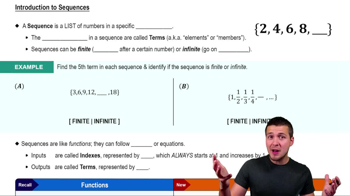
A recurrence relation defines each term of a sequence using previous terms. In this problem, the balance after each payment depends on the previous balance and the new deposit, making it essential to express Bₙ in terms of Bₙ₋₁. Understanding how to set up such relations helps model the growth of the savings over time.
Recommended video:
04:16
Intro To Related Rates

Compound Interest

Compound interest means interest is earned on both the initial principal and the accumulated interest from previous periods. Here, the account earns 0.75% interest monthly, which is added before the deposit. Recognizing how interest compounds monthly is crucial to correctly formulating the recurrence.
Recommended video:
4:47
The Number e

Sequence and Series in Financial Contexts

Sequences represent the balance after each payment, and understanding their behavior helps analyze savings growth. Financial sequences often involve regular deposits and interest accumulation, requiring knowledge of how to combine arithmetic (deposits) and geometric (interest) components in the recurrence.
Recommended video:
Guided course
8:22
Introduction to Sequences
Related Practice