
Textbook Question
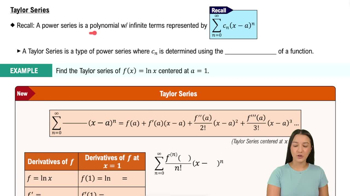
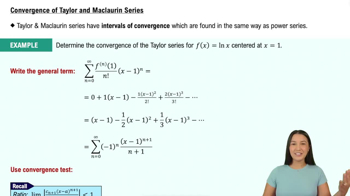
Evaluating an infinite series Write the Maclaurin series for f(x) = ln (1+x) and find the interval of convergence. Evaluate f(−1/2) to find the value of ∑ₖ₌₁∞ 1/(k 2ᵏ)
116
views

 Verified step by step guidance
 08:42
08:42
 08:26
08:26 05:44
05:44Evaluating an infinite series Write the Maclaurin series for f(x) = ln (1+x) and find the interval of convergence. Evaluate f(−1/2) to find the value of ∑ₖ₌₁∞ 1/(k 2ᵏ)
Binomial series Write out the first three terms of the Maclaurin series for the following functions.
ƒ(x) = (1 + 2x)^(-5)
Combining power series Use the geometric series
f(x) = 1/(1-x) = ∑ₖ₌₀∞ xᵏ, for |x| < 1,
to find the power series representation for the following functions (centered at 0). Give the interval of convergence of the new series.
g(x) = x³/(1 − x)
Differentiating and integrating power series Find the power series representation for g centered at 0 by differentiating or integrating the power series for f (perhaps more than once). Give the interval of convergence for the resulting series.
g(x) = 2/(1 − 2x)² using f(x) = 1/(1 − 2x)
Radius of convergence Find the radius of convergence for the following power series.
∑ₖ₌₁∞ (k!xᵏ)/(kᵏ)
Combining power series Use the power series representation
f(x ) =ln (1 − x) = −∑ₖ₌₁∞ xᵏ/k, for −1 ≤ x < 1,
to find the power series for the following functions (centered at 0). Give the interval of convergence of the new series.
p(x) = 2x⁶ ln(1 − x)