Evaluating an infinite series Write the Maclaurin series for f(x) = ln (1+x) and find the interval of convergence. Evaluate f(−1/2) to find the value of ∑ₖ₌₁∞ 1/(k 2ᵏ)
Ch. 11 - Power Series
Briggs3rd EditionCalculus: Early TranscendentalsISBN: 9780136847243Not the one you use?Change textbook
Chapter 11, Problem 11.2.49
Combining power series Use the power series representation
f(x ) =ln (1 − x) = −∑ₖ₌₁∞ xᵏ/k, for −1 ≤ x < 1,
to find the power series for the following functions (centered at 0). Give the interval of convergence of the new series.
p(x) = 2x⁶ ln(1 − x)
Verified step by step guidance1
Recall the given power series for \( f(x) = \ln(1 - x) \):
\[ f(x) = \ln(1 - x) = -\sum_{k=1}^{\infty} \frac{x^k}{k}, \quad \text{for } -1 \leq x < 1. \]
To find the power series for \( p(x) = 2x^6 \ln(1 - x) \), multiply the entire series for \( \ln(1 - x) \) by \( 2x^6 \):
\[ p(x) = 2x^6 \cdot \left(-\sum_{k=1}^{\infty} \frac{x^k}{k}\right) = -2x^6 \sum_{k=1}^{\infty} \frac{x^k}{k}. \]
Combine the powers of \( x \) inside the summation:
\[ p(x) = -2 \sum_{k=1}^{\infty} \frac{x^{k+6}}{k}. \]
Rewrite the series with a new index if desired (for example, let \( n = k + 6 \)) to express the series in standard power series form centered at 0:
\[ p(x) = -2 \sum_{n=7}^{\infty} \frac{x^n}{n - 6}. \]
Determine the interval of convergence. Since the original series for \( \ln(1 - x) \) converges for \( -1 \leq x < 1 \), and multiplication by \( 2x^6 \) does not affect the radius of convergence, the interval of convergence for \( p(x) \) remains \( -1 \leq x < 1 \).

Verified video answer for a similar problem:
This video solution was recommended by our tutors as helpful for the problem above.
Video duration:
5mWas this helpful?
Key Concepts
Here are the essential concepts you must grasp in order to answer the question correctly.
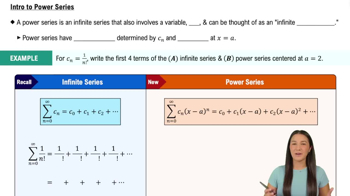
Power Series Representation
A power series expresses a function as an infinite sum of terms involving powers of x, typically centered at a point (here, 0). Understanding how to write and manipulate these series is essential for representing functions like ln(1 − x) as sums that converge within a specific interval.
Recommended video:
Intro to Power Series
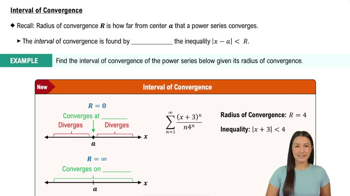
Interval of Convergence
The interval of convergence is the set of x-values for which a power series converges to the function it represents. Determining this interval ensures the validity of the series representation and is crucial when modifying or combining series, such as multiplying by 2x⁶.
Recommended video:
Interval of Convergence
Operations on Power Series
Power series can be added, multiplied, or composed by manipulating their coefficients and powers of x. For example, multiplying ln(1 − x) by 2x⁶ involves shifting the powers and scaling coefficients, which requires careful term-by-term adjustment to find the new series.
Recommended video:
Intro to Power Series
Related Practice
Textbook Question
116
views
Textbook Question
Approximating real numbers Use an appropriate Taylor series to find the first four nonzero terms of an infinite series that is equal to the following numbers.
cos 2
67
views
Textbook Question
Write out the first three terms of the Maclaurin series for the following functions.
ƒ(x) = (1 + x)^(1/3)"
85
views
Textbook Question
Binomial series Write out the first three terms of the Maclaurin series for the following functions.
ƒ(x) = (1 + 2x)^(-5)
105
views
Textbook Question
Radius of convergence Find the radius of convergence for the following power series.
∑ₖ₌₁∞ (k!xᵏ)/(kᵏ)
87
views
Textbook Question
Approximating ln 2 Consider the following three ways to approximate
ln 2.
a. Use the Taylor series for ln (1 + x) centered at 0 and evaluate it at x = 1 (convergence was asserted in Table 11.5). Write the resulting infinite series.
62
views