Ch. 2 - Limits
Briggs - Calculus: Early Transcendentals 3rd Edition
Briggs3rd EditionCalculus: Early TranscendentalsISBN: 9780136847243Not the one you use?Change textbook
Chapter 2, Problem 2.6.76b

Assume you invest \(250 at the end of each year for 10 years at an annual interest rate of rr. The amount of money in your account after 10 years is given by A(r)=250((1+r)101)rA\left(r\right)=\frac{250\left(\left(1+r\right)^{10}-1\right)}{r}. Assume your goal is to have \)3500 in your account after 10 years.


b. Use a calculator to estimate the interest rate required to reach your financial goal.

Verified step by step guidance
1
Identify the equation for the amount in the account after 10 years: \( A(r) = \frac{250((1+r)^{10} - 1)}{r} \).
Set the equation equal to your financial goal: \( \frac{250((1+r)^{10} - 1)}{r} = 3500 \).
Rearrange the equation to isolate terms involving \( r \): \( 250((1+r)^{10} - 1) = 3500r \).
Simplify and solve for \( r \) using numerical methods or a calculator: \( (1+r)^{10} - 1 = \frac{3500r}{250} \).
Use a calculator to estimate \( r \) by trying different values until the left side of the equation is approximately equal to the right side.

Verified video answer for a similar problem:

This video solution was recommended by our tutors as helpful for the problem above.
Video duration:
4m
Was this helpful?

Key Concepts

Here are the essential concepts you must grasp in order to answer the question correctly.

Future Value of an Annuity

The future value of an annuity formula calculates the total amount of money accumulated after making regular investments over time, considering a specific interest rate. In this case, the formula A(r) = 250 * ((1 + r)^{10} - 1) / r represents the future value of investing $250 at the end of each year for 10 years at an interest rate r. Understanding this concept is crucial for determining how much money will be available after the investment period.
Recommended video:
05:03
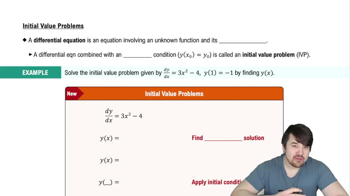
Initial Value Problems

Interest Rate

The interest rate is the percentage at which money grows over time when invested or borrowed. In this problem, the interest rate r is a variable that affects the future value of the annuity. Estimating the interest rate required to reach a specific financial goal, such as $3500, involves solving for r in the future value formula, which can be complex and may require numerical methods or financial calculators.
Recommended video:
04:16
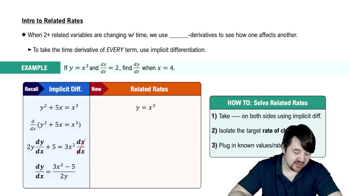
Intro To Related Rates

Numerical Methods

Numerical methods are techniques used to approximate solutions for mathematical problems that cannot be solved analytically. In this context, since the equation for future value involves the variable r in a non-linear way, numerical methods such as the Newton-Raphson method or bisection method can be employed to estimate the interest rate needed to achieve the desired future value. These methods are essential for finding solutions in real-world financial scenarios.
Recommended video:
6:47
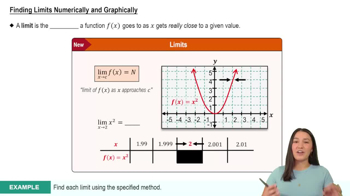
Finding Limits Numerically and Graphically
Related Practice
Textbook Question

Determine whether the following statements are true and give an explanation or counterexample.

The line x=−1 is a vertical asymptote of the function f(x) =x^2 − 7x + 6 / x^2 − 1.

281
views

Textbook Question

The hyperbolic cosine function, denoted cosh(x)\(\cosh\]\left\)(x\(\right\)), is used to model the shape of a hanging cable (a telephone wire, for example). It is defined as cosh(x)=ex+ex2\(\cosh\]\left\)(x\(\right\))=\(\frac{e^{x}\)+e^{-x}}{2}.


b. Evaluate cosh(0)\(\cosh\]\left\)(0\(\right\)). Use symmetry and part (a) to sketch a plausible graph for y=cosh(x)y=\(\cosh\]\left\)(x\(\right\)).

577
views
Textbook Question

Let g(x)={x2+xif x<1aif x=13x+5if x>1g\(\left\)(x\(\right\))=\(\begin{cases}\)x^2+x & \(\text{if }\)x<1\\ a & \(\text{if }\)x=1\\ 3x+5 & \(\text{if }\)x>1\(\end{cases}\)

b. Determine the value of aa for which gg is continuous from the right at 11

304
views
Textbook Question

Complete the following steps for the given functions. 


b. Find the vertical asymptotes of f (if any).


f(x)=3x22x+53x+4f\(\left\)(x\(\right\))=\(\frac{3x^2-2x+5}{3x+4}\)

346
views
Textbook Question

Use the graph of gg in the figure to find the following values or state that they do not exist. <IMAGE>

limx0g(x){\(\displaystyle\]\lim\)_{x\(\to\)0}g\(\left\)(x\(\right\))}

389
views
Textbook Question

Determine the following limits.


b. limx3x3x49x2{\(\displaystyle\]\lim\)_{x\(\to\)3}}\(\frac{x-3}{x^4-9x^2}\)

322
views