Ch. 2 - Limits
Briggs - Calculus: Early Transcendentals 3rd Edition
Briggs3rd EditionCalculus: Early TranscendentalsISBN: 9780136847243Not the one you use?Change textbook
Chapter 2, Problem 2.5.56b

Complete the following steps for the given functions. 


b. Find the vertical asymptotes of f (if any).


f(x)=3x22x+53x+4f\(\left\)(x\(\right\))=\(\frac{3x^2-2x+5}{3x+4}\)

Verified step by step guidance
1
Identify the vertical asymptotes by finding the values of x that make the denominator zero.
Set the denominator equal to zero: 3x + 4 = 0.
Solve the equation for x: 3x = -4.
Divide both sides by 3 to isolate x: x = -\(\frac{4}{3}\).
Conclude that the vertical asymptote is at x = -\(\frac{4}{3}\).

Verified video answer for a similar problem:

This video solution was recommended by our tutors as helpful for the problem above.
Video duration:
4m
Was this helpful?

Key Concepts

Here are the essential concepts you must grasp in order to answer the question correctly.

Vertical Asymptotes

Vertical asymptotes occur in rational functions where the denominator approaches zero while the numerator does not. These points indicate where the function's value tends to infinity or negative infinity. To find vertical asymptotes, set the denominator equal to zero and solve for the variable, ensuring that the numerator does not also equal zero at those points.
Recommended video:
3:40
Introduction to Cotangent Graph Example 1

Rational Functions

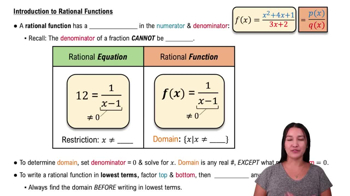
A rational function is a function represented by the ratio of two polynomials. The general form is f(x) = P(x)/Q(x), where P and Q are polynomials. Understanding the behavior of rational functions, particularly their asymptotic behavior, is crucial for analyzing their graphs and identifying points of discontinuity.
Recommended video:
6:04
Intro to Rational Functions

Polynomial Functions

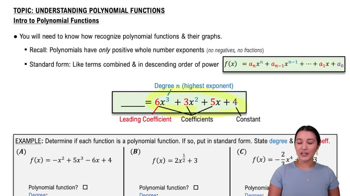
Polynomial functions are expressions that consist of variables raised to non-negative integer powers, combined using addition, subtraction, and multiplication. The degree of a polynomial indicates its highest power, which influences its end behavior and the number of roots it can have. In the context of rational functions, the behavior of the numerator polynomial is essential for determining limits and asymptotic behavior.
Recommended video:
6:04
Introduction to Polynomial Functions