

Angle to a particle (part 2) The figure in Exercise 81 shows the particle traveling away from the sensor, which may have influenced your solution (we expect you used the inverse sine function). Suppose instead that the particle approaches the sensor (see figure). How would this change the solution? Explain the differences in the two answers. <IMAGE>
15–48. Derivatives Find the derivative of the following functions.
y = 10^In 2x
Verified step by step guidance
Verified video answer for a similar problem:
Key Concepts
Derivatives
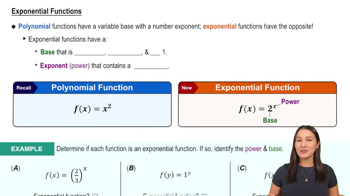
Exponential Functions
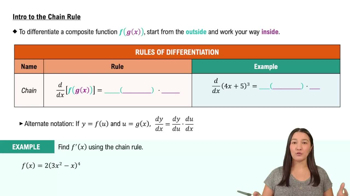
Chain Rule
49–55. Derivatives of tower functions (or g^h) Find the derivative of each function and evaluate the derivative at the given value of a.
h (x) = x^√x; a = 4
A cost function of the form C(x) = 1/2x² reflects diminishing returns to scale. Find and graph the cost, average cost, and marginal cost functions. Interpret the graphs and explain the idea of diminishing returns.
Find y'' for the following functions.
y = cos θ sin θ
Evaluate the derivative of the following functions.
f(x) = sin-1 (e-2x)
A 12-ft ladder is leaning against a vertical wall when Jack begins pulling the foot of the ladder away from the wall at a rate of 0.2 ft/s. What is the configuration of the ladder at the instant when the vertical speed of the top of the ladder equals the horizontal speed of the foot of the ladder?
