
Angle to a particle (part 2) The figure in Exercise 81 shows the particle traveling away from the sensor, which may have influenced your solution (we expect you used the inverse sine function). Suppose instead that the particle approaches the sensor (see figure). How would this change the solution? Explain the differences in the two answers. <IMAGE>
Ch. 3 - Derivatives
Briggs3rd EditionCalculus: Early TranscendentalsISBN: 9780136847243Not the one you use?Change textbook
Chapter 3, Problem 3.6.52
A cost function of the form C(x) = 1/2x² reflects diminishing returns to scale. Find and graph the cost, average cost, and marginal cost functions. Interpret the graphs and explain the idea of diminishing returns.
Verified step by step guidance1
To find the average cost function, divide the cost function C(x) by x. The average cost function is given by AC(x) = C(x)/x = (1/2)x.
To find the marginal cost function, take the derivative of the cost function C(x) with respect to x. The marginal cost function is MC(x) = d(C(x))/dx = x.
Graph the cost function C(x) = (1/2)x², the average cost function AC(x) = (1/2)x, and the marginal cost function MC(x) = x on the same set of axes. The cost function is a parabola opening upwards, the average cost function is a straight line through the origin with a positive slope, and the marginal cost function is also a straight line through the origin with a slope of 1.
Interpret the graphs: The cost function shows that as production increases, the cost increases at an increasing rate. The average cost function shows that the average cost per unit increases linearly with production. The marginal cost function shows that the cost of producing one more unit increases linearly with the number of units produced.
Explain diminishing returns: Diminishing returns to scale occur when increasing production leads to a less than proportional increase in output. In this context, as more units are produced, the cost per additional unit (marginal cost) increases, reflecting inefficiencies that arise with larger scale production.

Verified video answer for a similar problem:
This video solution was recommended by our tutors as helpful for the problem above.
Video duration:
2mWas this helpful?
Key Concepts
Here are the essential concepts you must grasp in order to answer the question correctly.
Cost Function
A cost function represents the total cost incurred by a firm in producing a certain level of output, denoted as C(x). In this case, C(x) = 1/2x² indicates that costs increase with the square of the output level, reflecting how production costs escalate as more units are produced.
Recommended video:
Properties of Functions
Marginal Cost
Marginal cost is the additional cost incurred from producing one more unit of output. It is derived from the cost function by taking the derivative, which in this case results in MC(x) = x. This concept is crucial for understanding how production decisions affect overall costs.
Recommended video:
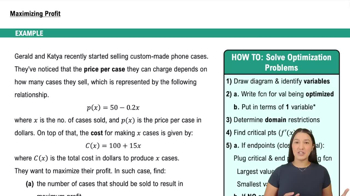
Example 3: Maximizing Profit
Diminishing Returns
Diminishing returns refer to the principle that as more units of a variable input are added to a fixed input, the additional output produced from each new unit of input will eventually decrease. This concept is illustrated in the cost functions, where increasing production leads to higher costs at an increasing rate, indicating inefficiencies in scaling.
Related Practice
Textbook Question
133
views
Textbook Question
49–55. Derivatives of tower functions (or g^h) Find the derivative of each function and evaluate the derivative at the given value of a.
h (x) = x^√x; a = 4
157
views
Textbook Question
Consider the curve x=e^y. Use implicit differentiation to verify that dy/dx = e^-y and then find d²y/dx² .
340
views
Textbook Question
15–48. Derivatives Find the derivative of the following functions.
y = 10^In 2x
362
views
Textbook Question
Find an equation of the line tangent to the curve y = sin x at x = 0.
352
views
Textbook Question
Find the slope of the curve y=sin-1 x at (1/2, π/6) without calculating the derivative of sin-1 x.
177
views
