Ch. 3 - Derivatives
Briggs - Calculus: Early Transcendentals 3rd Edition
Briggs3rd EditionCalculus: Early TranscendentalsISBN: 9780136847243Not the one you use?Change textbook
Chapter 3, Problem 3.2.23a

21–30. Derivatives
a. Use limits to find the derivative function f' for the following functions f.
f(x) = 4x²+1; a= 2,4

Verified step by step guidance
1
Start by recalling the definition of the derivative using limits: f'(x) = lim(h→0) [(f(x+h) - f(x))/h].
Substitute the given function f(x) = 4x² + 1 into the derivative definition: f'(x) = lim(h→0) [(4(x+h)² + 1 - (4x² + 1))/h].
Expand the expression (x+h)² to get x² + 2xh + h², and substitute it back into the limit: f'(x) = lim(h→0) [(4(x² + 2xh + h²) + 1 - 4x² - 1)/h].
Simplify the expression inside the limit: f'(x) = lim(h→0) [(4x² + 8xh + 4h² + 1 - 4x² - 1)/h] = lim(h→0) [(8xh + 4h²)/h].
Factor out h from the numerator and cancel it with the denominator: f'(x) = lim(h→0) [8x + 4h]. As h approaches 0, the term 4h vanishes, leaving f'(x) = 8x.

Verified video answer for a similar problem:

This video solution was recommended by our tutors as helpful for the problem above.
Video duration:
4m
Was this helpful?

Key Concepts

Here are the essential concepts you must grasp in order to answer the question correctly.

Derivative

The derivative of a function measures how the function's output value changes as its input value changes. It is defined as the limit of the average rate of change of the function over an interval as the interval approaches zero. In mathematical terms, the derivative f'(x) is given by the limit: f'(x) = lim(h→0) [f(x+h) - f(x)] / h.
Recommended video:
05:44
Derivatives

Limit

A limit is a fundamental concept in calculus that describes the behavior of a function as its input approaches a certain value. It is essential for defining derivatives and integrals. The limit allows us to analyze the function's behavior at points where it may not be explicitly defined, such as at points of discontinuity or at infinity.
Recommended video:
05:50
One-Sided Limits

Function Evaluation

Function evaluation involves substituting a specific value into a function to determine its output. In the context of finding derivatives, evaluating the function at points a=2 and a=4 is necessary to compute the derivative using the limit definition. This process helps in understanding how the function behaves at those specific points.
Recommended video:
4:26
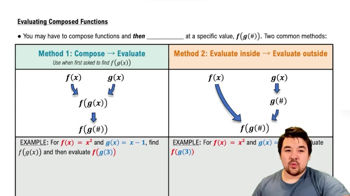
Evaluating Composed Functions
Related Practice
Textbook Question

Vertical tangent lines

a. Determine the points where the curve x+y³−y=1 has a vertical tangent line (see Exercise 60).

367
views

Textbook Question

Find an equation of the line tangent to the following curves at the given value of x.

y = 4 sin x cos x; x = π/3

326
views
Textbook Question

Highway travel A state patrol station is located on a straight north-south freeway. A patrol car leaves the station at 9:00 A.M. heading north with position function s = f(t) that gives its location in miles t hours after 9:00 A.M. (see figure). Assume s is positive when the car is north of the patrol station. <IMAGE>

a. Determine the average velocity of the car during the first 45 minutes of the trip.

303
views
Textbook Question

79–82. {Use of Tech} Visualizing tangent and normal lines <IMAGE>

a. Determine an equation of the tangent line and the normal line at the given point (x0, y0) on the following curves. (See instructions for Exercises 73–78.)

(x²+y²)² = 25/3 (x²-y²); (x0,y0) = (2,-1) (lemniscate of Bernoulli)

226
views
Textbook Question

The volume V of a sphere of radius r changes over time t.

a. Find an equation relating dV/dt to dr/dt.

334
views
Textbook Question

{Use of Tech} Approximating derivatives Assuming the limit exists, the definition of the derivative f′(a) = lim h→0 f(a + h) − f(a) / h implies that if ℎ is small, then an approximation to f′(a) is given by

f' (a) ≈ f(a+h) - f(a) / h. If ℎ > 0 , then this approximation is called a forward difference quotient; if ℎ < 0 , it is a backward difference quotient. As shown in the following exercises, these formulas are used to approximate f′ at a point when f is a complicated function or when f is represented by a set of data points. <IMAGE>

Let f (x) = √x.

a. Find the exact value of f' (4).

245
views