
Textbook Question
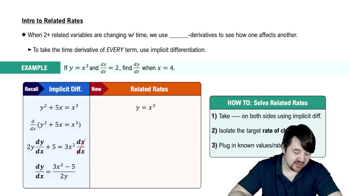
Vertical tangent lines
a. Determine the points where the curve x+y³−y=1 has a vertical tangent line (see Exercise 60).
367
views

 Verified step by step guidance
 04:16
04:16
 08:29
08:29 05:02
05:02Vertical tangent lines
a. Determine the points where the curve x+y³−y=1 has a vertical tangent line (see Exercise 60).
Highway travel A state patrol station is located on a straight north-south freeway. A patrol car leaves the station at 9:00 A.M. heading north with position function s = f(t) that gives its location in miles t hours after 9:00 A.M. (see figure). Assume s is positive when the car is north of the patrol station. <IMAGE>
a. Determine the average velocity of the car during the first 45 minutes of the trip.
21–30. Derivatives
a. Use limits to find the derivative function f' for the following functions f.
f(x) = 4x²+1; a= 2,4
62–65. {Use of Tech} Graphing f and f'
a. Graph f with a graphing utility.
f(x)=e^−x tan^−1 x on [0,∞)
Derivatives and tangent lines
a. For the following functions and values of a, find f′(a).
f(x) = 1/ √x; a= 1/4
79–82. {Use of Tech} Visualizing tangent and normal lines <IMAGE>
a. Determine an equation of the tangent line and the normal line at the given point (x0, y0) on the following curves. (See instructions for Exercises 73–78.)
(x²+y²)² = 25/3 (x²-y²); (x0,y0) = (2,-1) (lemniscate of Bernoulli)